
Chapter 4
Engine Ignition & Electrical Systems
the leads between the transformer coils and the spark plugs of a low-tension ignition system are short, they are high-tension high-voltage conductor, and are subject to the same failures that occur in high-tension systems. Low-tension ignition systems have limited use in modern aircraft because of the excellent materials and shielding available to construct hightension ignition leads and the added cost of a coil for each spark plug with the low-tension system.
Types of DC Generators
There are three types of DC generators: series wound, parallel (shunt) wound, and series-parallel (compound) wound. The appropriate generator is determined by the connections to the armature and field circuits with respect to the external circuit. The external circuit is the electrical load powered by the generator. In general, the external circuit is used for charging the aircraft battery and supplying power to all electrical equipment being used by the aircraft. As their names imply, windings in series have characteristics different from windings in parallel.
Series Wound DC Generators
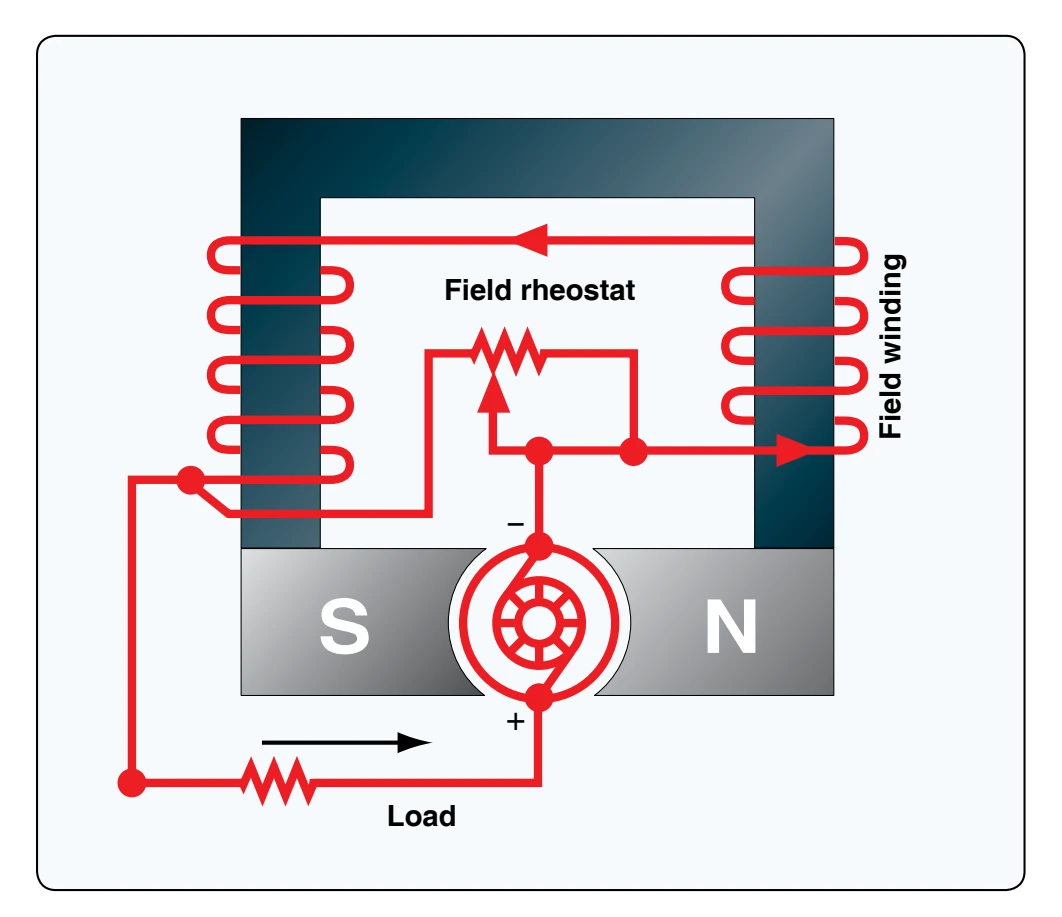
The series generator contains a field winding connected in series with the external circuit. [Figure 4-21] Series generators have very poor voltage regulation under changing load, since the greater the current is through the field coils to the external circuit, the greater the induced EMFs and the greater the output voltage is. When the aircraft electrical load is increased, the voltage increases; when the load is decreased, the voltage decreases.
Since the series wound generator has such poor voltage and current regulation, it is never employed as an airplane generator. Generators in airplanes have field windings, that
are connected either in shunt or in compound formats.
Parallel (Shunt) Wound DC Generators
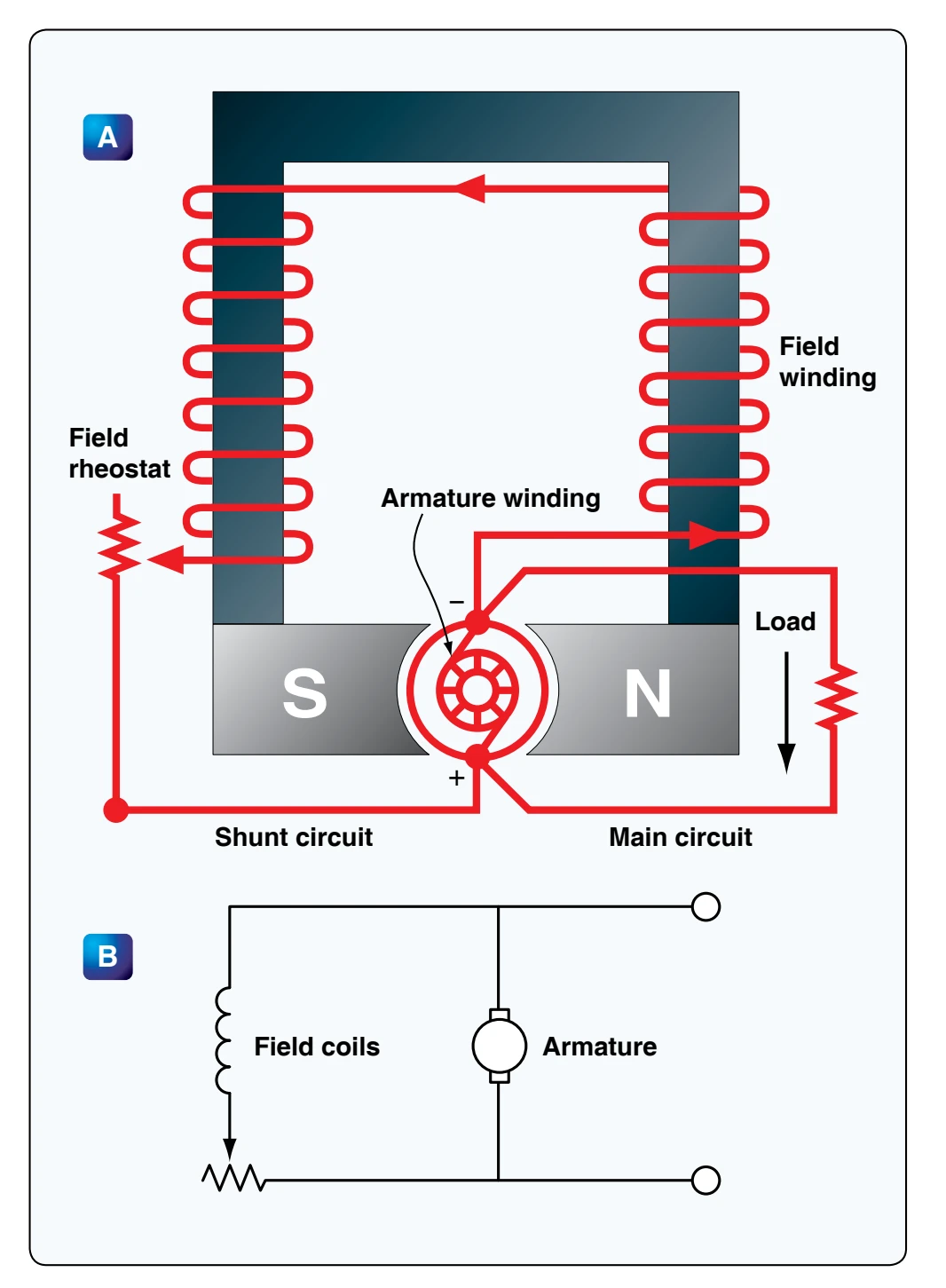
A generator having a field winding connected in parallel with the external circuit is called a shunt generator. [Figure 4-22] It should be noted that, in electrical terms, shunt means parallel. Therefore, this type of generator could be called either a shunt generator or a parallel generator.
In a shunt generator, any increase in load causes a decrease in the output voltage, and any decrease in load causes an increase output voltage. This occurs since the field winding is connected in parallel to the load and armature, and all the current flowing in the external circuit passes only through the armature winding (not the field).
As shown in Figure 4-22A, the output voltage of a shunt generator can be controlled by means of a rheostat inserted in series with the field windings. As the resistance of the field circuit is increased, the field current is reduced; consequently, the generated voltage is also reduced. As the field resistance is decreased, the field current increases and the generator output increases. In the actual aircraft, the field rheostat would be replaced with an automatic control device, such
as a voltage regulator.
Compound Wound DC Generators
A compound wound generator employs two field windings one in series and another in parallel with the load. [Figure 4-23]
This arrangement takes advantage of both the series and parallel characteristics described earlier. The output of a compound wound generator is relatively constant, even with changes in the load.
Generator Ratings
A DC generator is typically rated for its voltage and power output. Each generator is designed to operate at a specified voltage, approximately 14 or 28 volts. It should be noted that aircraft electrical systems are designed to operate at one of these two voltage values. The aircraft’s voltage depends on which battery is selected for that aircraft. Batteries are either 12 or 24 volts when fully charged. The generator selected must have a voltage output slightly higher than the battery voltage. Hence, the 14- or 28-volt rating is required for aircraft DC generators.
The power output of any generator is given as the maximum number of amperes the generator can safely supply. Generator rating and performance data are stamped on the nameplate