
Chapter 6
Lubrication & Cooling Systems
Maintenance of gas turbine lubrication systems consists mainly of adjusting, removing, cleaning, and replacing various components. Oil filter maintenance and oil change intervals for turbine engines vary widely from model to model, depending on the severity of the oil temperature conditions imposed by the specific airframe installation and engine configuration. The applicable manufacturer’s instructions should be followed. The oil filter should be removed at every regular inspection. It should be disassembled, cleaned, and any worn or damaged filter elements replaced. The following steps illustrate typical oil filter removal cleaning and replacement procedures:
- Provide a suitable container for collecting the drained oil, if needed.
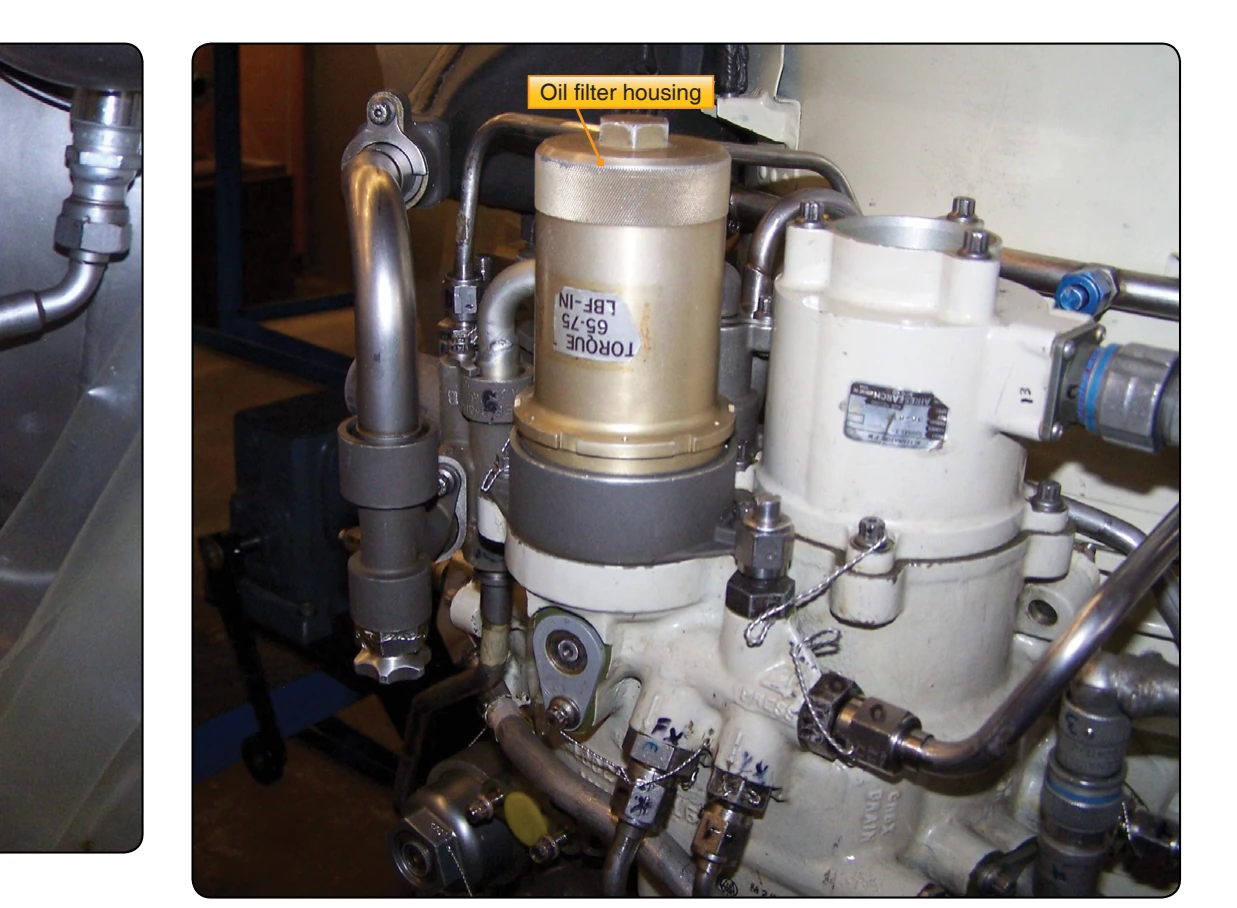
- Remove the filter housing and withdraw the filter assembly. [Figure 6-48] Discard the old seals.
- Immerse the screen or filter in an approved carbon remover at room temperature for a few minutes. Rinse them in a degreaser fluid or cleaning solvent. Then, blow them dry with an air jet.
- Then, install the filter in the filter housing assembly. Place a new seal and tighten it to the torque prescribed in the manufacturer’s instructions.
- Secure with lock wire.
To adjust the oil pressure, first remove the adjusting screw acorn cap on the oil pressure relief valve. Then, loosen the locknut and turn the adjusting screw clockwise to increase, or counterclockwise to decrease, the oil pressure. In a typical turbojet lubrication system, the adjusting screw is adjusted to provide an oil pressure of 45, ±5 psi, at approximately 75 percent of normal rated thrust. The adjustment should be made while the engine is idling; it may be necessary to perform several adjustments before the desired pressure is obtained. When the proper pressure setting is achieved, tighten the adjusting screw locknut, and install the acorn cap with a new gasket, then tighten and secure with lock wire.
Checking or servicing aircraft engine oil is an important maintenance function. Before servicing any aircraft engine, consult the specific aircraft maintenance manual to determine the proper type of servicing equipment and procedures. In general, aircraft engine oil is checked with a dipstick or a sight gauge. There are markings on the stick or around the sight gauge to determine the correct level. Turbine engines must be checked just after shutdown.
Maintenance of scavenge and breather systems at regular inspections includes checks for oil leaks and security of mounting of system components. Also, check chip detectors for particles of ferrous material and clean last-chance filters; install and safety.
Engine Cooling Systems
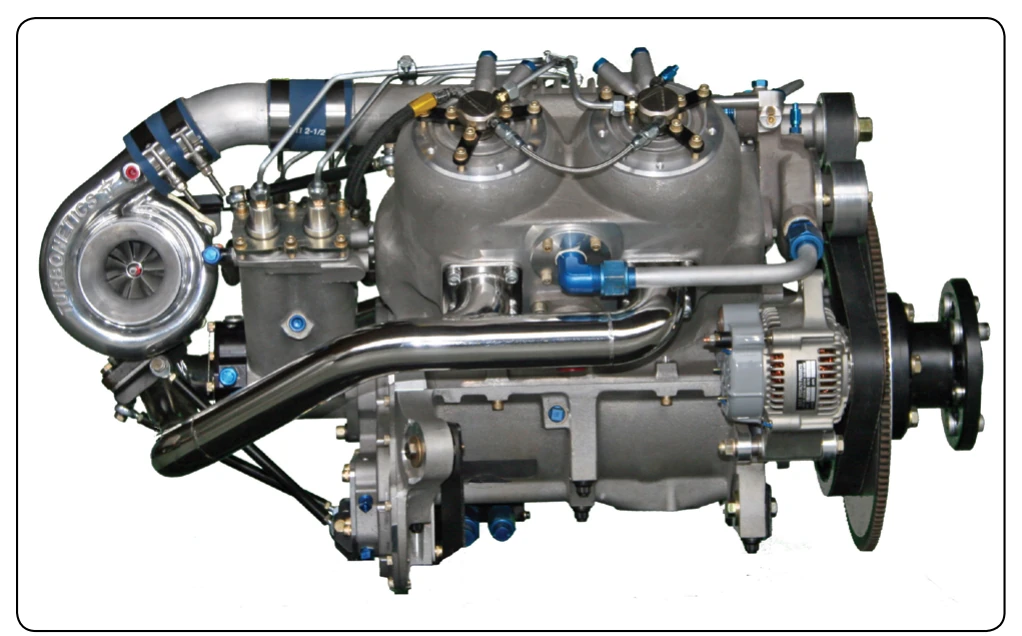
Excessive heat is always undesirable in both reciprocating and turbine aircraft engines. If means were not available for its control or elimination, major damage or complete engine failure would occur. Although the vast majority of reciprocating engines are air cooled, some diesel liquidcooled engines are being made available for light aircraft. [Figure 6-49] In a liquid-cooled engine, around the cylinder are water jackets, in which liquid coolant is circulated and the coolant takes away the excess heat. The excess heat is then dissipated by a heat exchanger or radiator using air flow. Turbine engines use secondary airflow to cool the inside components and many of the exterior components.
Reciprocating Engine Cooling Systems
An internal-combustion engine is a heat machine that converts chemical energy in the fuel into mechanical energy at the crankshaft. It does not do this without some loss of energy, however, and even the most efficient aircraft engines may waste 60 to 70 percent of the original energy in the fuel. Unless most of this waste heat is rapidly removed, the cylinders may become hot enough to cause complete engine failure. Excessive heat is undesirable in any internalcombustion engine for three principal reasons:
- It affects the behavior of the combustion of the air-fuel charge.
- It weakens and shortens the life of engine parts.
- It impairs lubrication.
If the temperature inside the engine cylinder is too great, the air-fuel mixture is preheated, and combustion occurs before the desired time. Since premature combustion causes
detonation, knocking, and other undesirable conditions, there must be a way to eliminate heat before it causes damage.
One gallon of aviation gasoline has enough heat value to boil 75 gallons of water; thus, it is easy to see that an engine that burns 4 gallons of fuel per minute releases a tremendous amount of heat. About one-fourth of the heat released is changed into useful power. The remainder of the heat must be dissipated so that it is not destructive to the engine. In a typical aircraft powerplant, half of the heat goes out with the exhaust and the other is absorbed by the engine. Circulating oil picks up part of this soaked-in heat and transfers it to the airstream through the oil cooler. The engine cooling system takes care of the rest. Cooling is a matter of transferring the excess heat from the cylinders to the air, but there is more to such a job than just placing the cylinders in the airstream. A cylinder on a large engine is roughly the size of a gallon jug. Its outer surface, however, is increased by the use of cooling fins so that it presents a barrel-sized exterior to the cooling air. Such an arrangement increases the heat transfer by convection. If too much of the cooling fin area is broken off, the cylinder cannot cool properly, and a hotspot develops. Therefore, cylinders are normally replaced if a specified number of square inches of fins are missing.
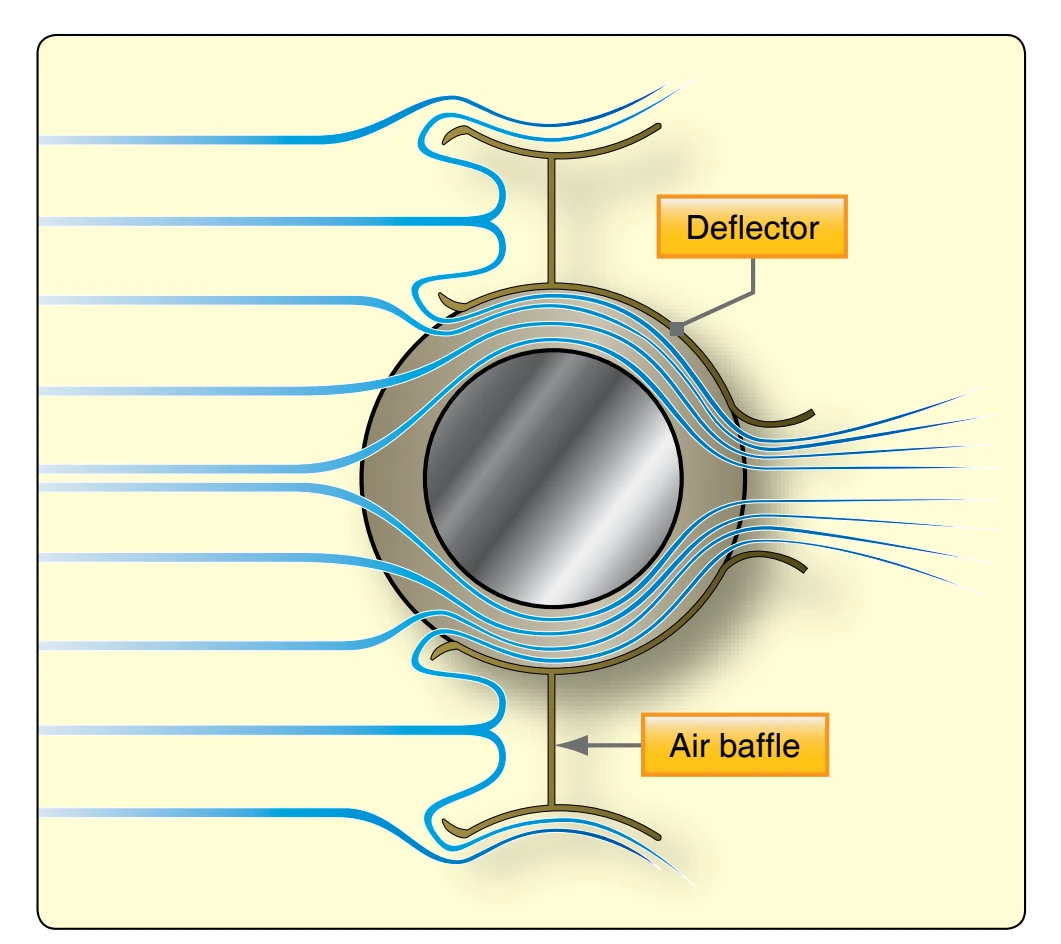
Cowling and baffles are designed to force air over the cylinder cooling fins. [Figure 6-50] The baffles direct the air close around the cylinders and prevent it from forming hot pools of stagnant air while the main streams rush by unused. Blast tubes are built into the baffles to direct jets of cooling air onto the rear spark plug elbows of each cylinder to prevent overheating of ignition leads. Blast tubes also provide cooling to engine accessories such as alternators, generators, and starters.
An engine can have an operating temperature that is too low. For the same reasons that an engine is warmed up before takeoff, it is kept warm during flight. Fuel evaporation and distribution and oil circulation depend on an engine being kept at its optimum operating temperature. The aircraft engine has temperature controls that regulate air circulation over the engine. Unless some controls are provided, the engine could overheat on takeoff and get too cold in high altitude, high-speed and low-power letdowns.
The most common means of controlling cooling is the use of cowl flaps. [Figure 6-51] These flaps are opened and closed by electric motor-driven jackscrews, by hydraulic actuators, or manually in some light aircraft. When extended for increased cooling, the cowl flaps produce drag and sacrifice streamlining for the added cooling. On takeoff, the cowl flaps are opened only enough to keep the engine below the red-line temperature. Heating above the normal range is allowed so that drag is as low as possible. During ground operations, the cowl flaps should be opened wide since drag does not matter and cooling needs to be set at maximum. Cowl flaps are used mostly with older aircraft and radial engine installations.