
Chapter 2
Aerodynamics of Flight
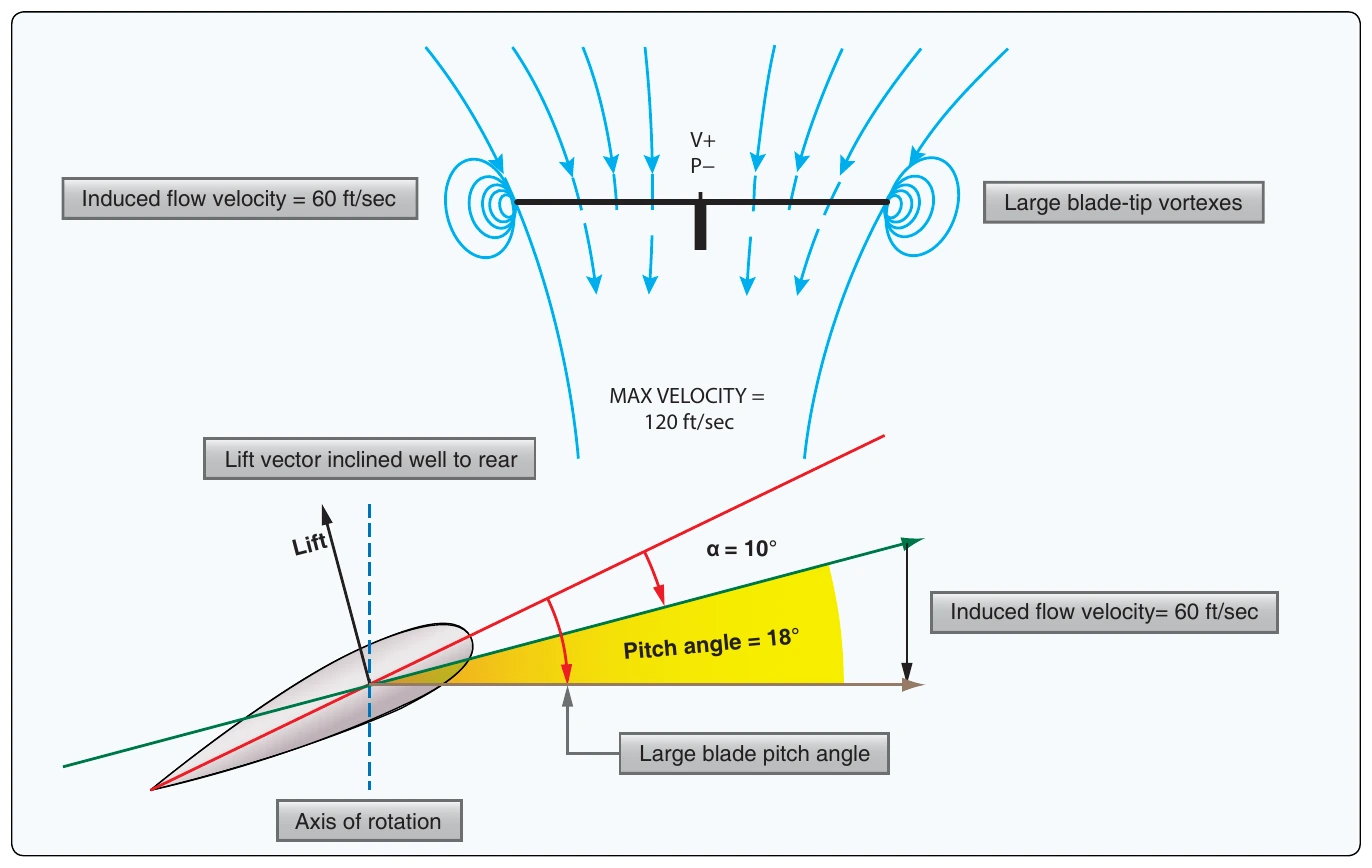
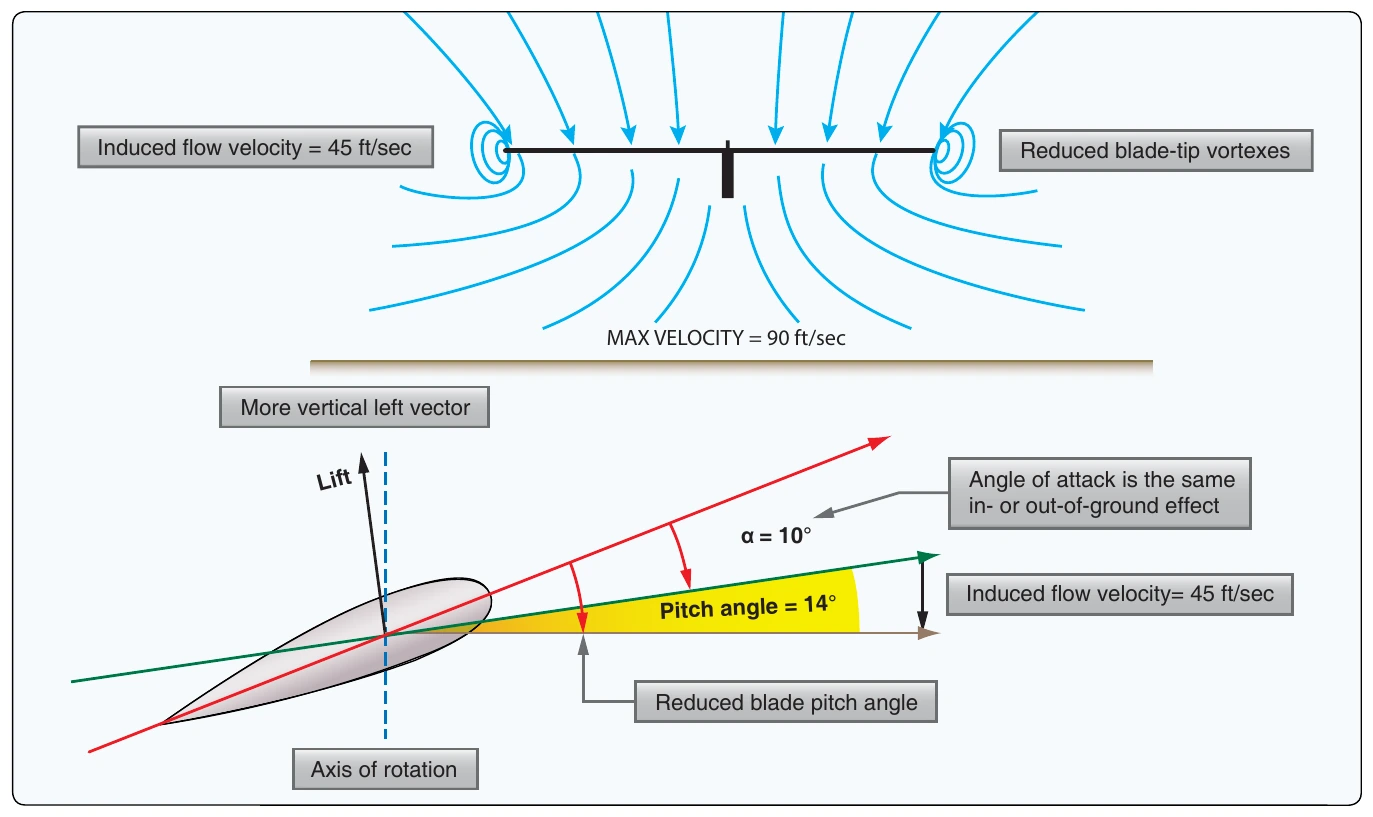
The benefit of placing the helicopter near the ground is lost above IGE altitude. Above this altitude, the power required to hover remains nearly constant, given similar conditions (such as wind). Induced flow velocity is increased, resulting in a decrease in AOA and a decrease in lift. Under the correct circumstances, this downward flow can become so localized that the helicopter and locally disturbed air will sink at alarming rates. This effect is called vortex ring state (formerly referenced as settling-with-power) and is discussed at length in Chapter 11, Helicopter Emergencies and Hazards. A higher blade pitch angle is required to maintain the same AOA as in IGE hover. The increased pitch angle also creates more drag. This increased pitch angle and drag requires more power to hover OGE than IGE. [Figure 2-23]
Rotor Blade Angles
There are two angles that enable a rotor disk to produce the lift required for a helicopter to fly: angle of incidence and angle of attack.
Angle of Incidence
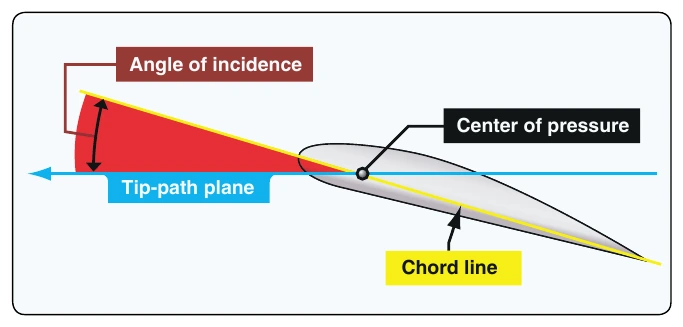
Angle of incidence is the angle between the chord line of a main or tail rotor blade and its rotor disk. It is a mechanical angle rather than an aerodynamic angle and is sometimes referred to as blade pitch angle. [Figure 2-24] In the absence of induced flow, AOA and angle of incidence are the same. Whenever induced flow, up flow (inflow), or airspeed modifies the relative wind, the AOA is different from the angle of incidence. Collective input and cyclic feathering (see page 2-12) change the angle of incidence. A change in the angle of incidence changes the AOA, which changes the coefficient of lift, thereby changing the lift produced by the airfoil.
Angle of Attack
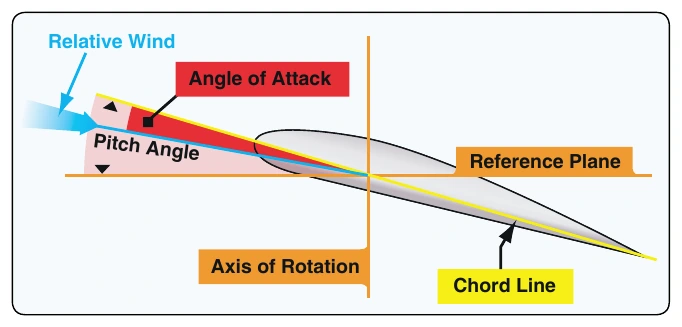
AOA is the angle between the airfoil chord line and resultant relative wind. [Figure 2-25] It is an aerodynamic angle and not easy to measure. It can change with no change in the blade pitch angle (angle of incidence, discussed earlier).
When the AOA is increased, air flowing over the airfoil is diverted over a greater distance, resulting in an increase of air velocity and more lift. As the AOA is increased further, it becomes more difficult for air to flow smoothly across the top of the airfoil. At this point, the airflow begins to separate from the airfoil and enters a burbling or turbulent pattern. The turbulence results in a large increase in drag and loss of lift in the area where it is taking place. Increasing the AOA increases lift until the critical angle of attack is reached. Any increase in the AOA beyond this point produces a stall and a rapid decrease in lift (refer to the Low Rotor RPM and Rotor Stall section of Chapter 11, Helicopter Emergencies and Hazards).
Several factors may change the rotor blade AOA. The pilot has little direct control over AOA except indirectly through the flight control input. Collective and cyclic feathering help to make these changes. Feathering is the rotation of the blade about its longitudinal axis by collective/cyclic inputs causing changes in blade pitch angle. Collective feathering changes angle of incidence equally and in the same direction on all rotor blades simultaneously. This action changes AOA, which changes coefficient of lift (CL), and affects overall lift of the rotor disk.
Cyclic feathering changes the blade’s AOA differentially around the rotor disk and creates a differential lift. Aviators use cyclic feathering to control attitude of the rotor disk. It is the means to control rearward tilt of the rotor (blowback) caused by flapping action and (along with blade flapping) counteract dissymmetry of lift (discussed in chapter 3). Cyclic feathering causes attitude of the rotor disk to change but does not change the amount of net lift the rotor disk is producing.
Most of the changes in AOA come from change in airspeed and rate of climb or descent; others such as flapping occur automatically due to the rotor system design. Flapping is the up and down movement of rotor blades about a hinge on a fully articulated rotor system. A semi-rigid system does not have a hinge but flap as a unit. A rigid rotor system has no vertical or horizontal hinges, so the blades cannot flap or drag, but they can flex. By flexing, the blades themselves compensate for the forces which previously required rugged hinges. It occurs in response to changes in lift due to changing velocity or cyclic feathering. No flapping occurs when the tip-path plane is perpendicular to the mast. The flapping action alone, or along with cyclic feathering, controls dissymmetry of lift. Flapping is the primary means of compensating for dissymmetry of lift.
Pilots adjust AOA through normal control manipulation of the pitch angle of the blades. If the pitch angle is increased, the AOA increases; if the pitch angle is reduced, the AOA is reduced.
Powered Flight
In powered flight (hovering, vertical, forward, sideward, or rearward), the total lift and thrust forces of a rotor are perpendicular to the rotor disk.
Hovering Flight
Hovering is the most challenging part of flying a helicopter. This is because a helicopter generates its own gusty air while in a hover, which acts against the fuselage and flight control surfaces. The end result is constant control inputs and corrections by the pilot to keep the helicopter where it is required to be. Despite the complexity of the task, the control inputs in a hover are simple. The cyclic is used to eliminate drift in the horizontal plane, controlling forward, backward, right and left movement or travel. The throttle, if not governor controlled, is used to control revolutions per minute (rpm). The collective is used to maintain altitude. The pedals are used to control nose direction or heading. It is the interaction of these controls that makes hovering difficult, since an adjustment in any one control requires an adjustment of the other two, creating a cycle of constant correction. During hovering flight, a helicopter maintains a constant position over a selected point, usually a few feet above the ground. The ability of the helicopter to hover comes from the both the lift component, which is the force developed by the main rotor(s) to overcome gravity and aircraft weight, and the thrust component, which acts horizontally to accelerate or decelerate the helicopter in the desired direction. Pilots direct the thrust of the rotor disk by using the cyclic to rotate the rotor disk plane relative to the horizon. They do this in order to induce travel or compensate for the wind and hold a position. At a hover in a no-wind condition, all opposing forces (lift, thrust, drag, and weight) are in balance; they are equal and opposite. Therefore, lift and weight are equal, resulting in the helicopter remaining at a stationary hover. [Figure 2-26]