
Chapter 7
Airplane Basic Flight Maneuvers
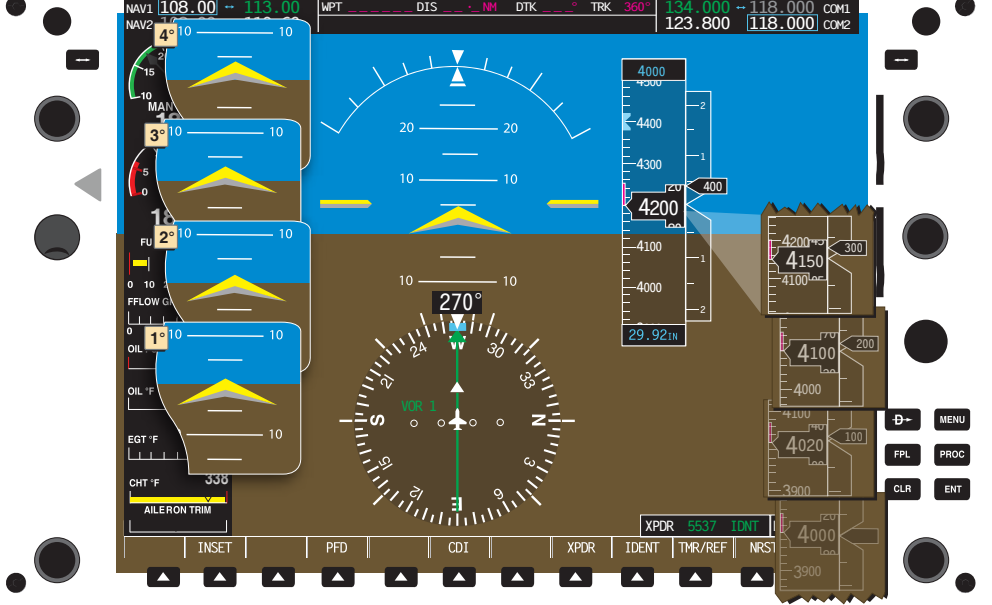
The full height of the chevron is approximately 5 degrees and provides an accurate reference for pitch adjustment. It is imperative that the pilot make the desired changes to pitch by referencing the attitude indicator and then trimming off any excess control pressures. Relieving these pressures allow for a more stabilized flight and reduces pilot work load. Once the aircraft is trimmed for level flight, the pilot must smoothly and precisely manipulate the elevator control forces in order to change the pitch attitude.
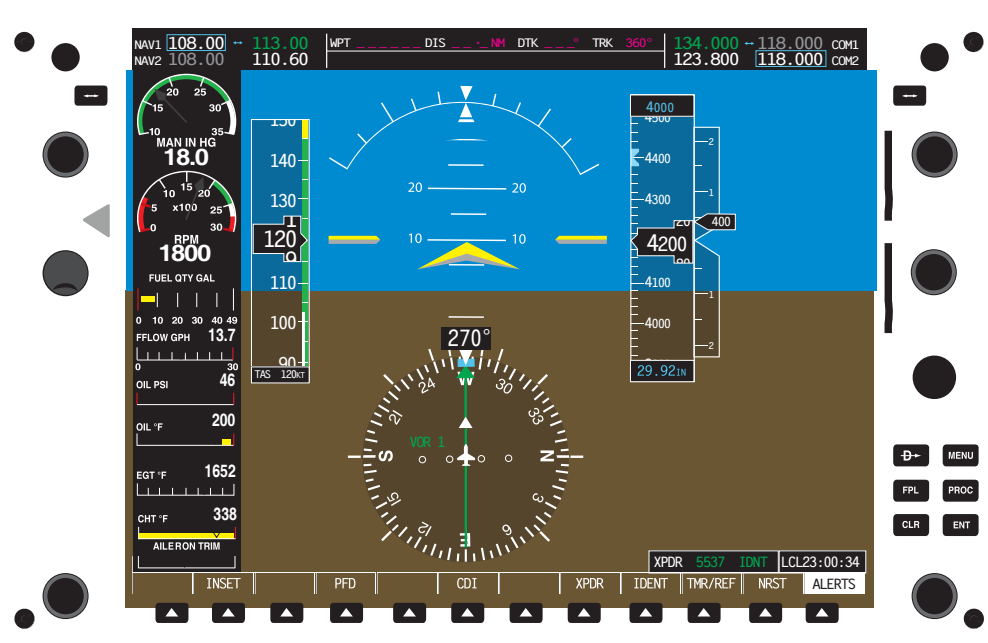
To master the ability to smoothly control the elevator, a pilot must develop a very light touch on the control yoke. The thumb and two fingers are normally sufficient to move the control yoke. The pilot should avoid griping the yoke with a full fist. When a pilot grips the yoke with a full fist, there is a tendency to apply excess pressures, thus changing the aircraft attitude.
Practice making smooth, small pitch changes both up and down until precise corrections can be made. With practice, a pilot is able to make pitch changes in 1 degree increments, smoothly controlling the attitude of the aircraft.
The last step in mastering elevator control is trim. Trimming the aircraft to relieve any control pressures is essential for smooth attitude instrument flight. To accomplish this, momentarily release the control yoke. Note which way the aircraft pitch attitude wants to move. Grasp the control yoke again and then reapply the pressure to return the attitude to the previous position. Apply trim in the direction of the control pressure. Small applications of trim make large changes in the pitch attitude. Be patient and make multiple changes to trim, if necessary.
Once the aircraft is in trim, relax on the control yoke as much as practicable. When pressure is held on the yoke, unconscious pressures are applied to the elevator and ailerons, which displaces the aircraft from its desired flightpath. If the aircraft is in trim, in calm, non-turbulent air, a pilot should be able to release the control yoke and maintain level flight for extended periods of time. This is one of the hardest skills to learn prior to successfully flying in instrument meteorological conditions (IMC).
Altimeter
At constant power, any deviation from level flight (except in turbulent air) must be the result of a pitch change. If the power is constant, the altimeter gives an indirect indication of the pitch attitude in level flight. Since the altitude should remain constant when the airplane is in level flight, any deviation from the desired altitude signals the need for a pitch change. For example, if the aircraft is gaining altitude, the nose must be lowered.
In the PFD, as the pitch starts to change, the altitude trend indicator on the altitude tape begins to show a change in the direction of displacement. The rate at which the trend indicator grows and the altimeter numbers change aids the pilot in determining how much of a pitch change is necessary to stop the trend.
As a pilot becomes familiar with a specific aircraft’s instruments, he or she learns to correlate pitch changes, altimeter tapes, and altitude trend indicators. By adding the altitude tape display and the altitude trend indicator into the scan along with the attitude indicator, a pilot starts to develop the instrument cross-check.
Partial Panel Flight
One important skill to practice is partial panel flight by referencing the altimeter as the primary pitch indicator. Practice controlling the pitch by referencing the altitude tape and trend indicator alone without the use of the attitude indicator. Pilots need to learn to make corrections to altitude deviations by referencing the rate of change of the altitude tape and trend indicator. When operating in IMC and in a partial panel configuration, the pilot should avoid abrupt changes to the control yoke. Reacting abruptly to altitude changes can lead to large pitch changes and thus a larger divergence from the initial altitude.
When a pilot is controlling pitch by the altitude tape and altitude trend indicators alone, it is possible to overcontrol the aircraft by making a larger than necessary pitch correction. Overcontrolling causes the pilot to move from a nose-high attitude to a nose-low attitude and vice versa. Small changes to pitch are required to insure prompt corrective actions are taken to return the aircraft to its original altitude with less confusion.
When an altitude deviation occurs, two actions need to be accomplished. First, make a smooth control input to stop the needle movement. Once the altitude tape has stopped moving, make a change to the pitch attitude to start back to the entry altitude.
During instrument flight with limited instrumentation, it is imperative that only small and precise control inputs are made. Once a needle movement is indicated denoting a deviation in altitude, the pilot needs to make small control inputs to stop the deviation. Rapid control movements only compound the deviation by causing an oscillation effect. This type of oscillation can quickly cause the pilot to become disoriented and begin to fixate on the altitude. Fixation on the altimeter can lead to a loss of directional control as well as airspeed control.
As a general rule of thumb, for altitude deviations less than 100 feet, utilize a pitch change of 1 degree, which equates to ⁄ of the thickness of the chevron. Small incremental pitch changes allow the performance to be evaluated and eliminate overcontrolling of the aircraft.
Instrumentation needs to be utilized collectively, but failures will occur that leave the pilot with only limited instrumentation. That is why partial panel flying training is important. If the pilot understands how to utilize each instrument independently, no significant change is encountered in carrying out the flight when other instruments fail.
VSI Tape
The VSI tape provides for an indirect indication of pitch attitude and gives the pilot a more immediate indication of a pending altitude deviation. In addition to trend information, the vertical speed also gives a rate indication. By using the VSI tape in conjunction with the altitude trend tape, a pilot has a better understanding of how much of a correction needs to be made. With practice, the pilot will learn the performance of a particular aircraft and know how much pitch change is required in order to correct for a specific rate indication.