
Chapter 7
Airplane Basic Flight Maneuvers
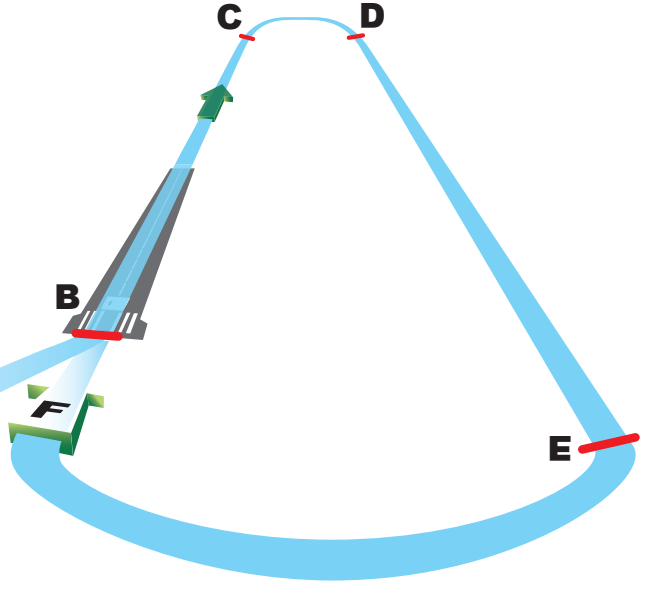
- At A, start timing for 2 minutes from A to B; reduce airspeed to approach speed. [Figure 7-46]
- At B, make a standard rate turn to the left for 45°.
- At the completion of the turn, time for 1 minute to C.
- At C, turn right for 180° to D; fly for 1-1/2 minutes to E, lowering the landing gear and flaps.
- At E, turn right for 180°, rolling-out at F.
- At F, enter a 500 fpm rate descent. At the end of a 500 foot descent, enter a straight constant-airspeed climb, retracting gear and flaps.
Section II — Electronic Flight Display
Introduction
The previous chapters have laid the foundation for instrument flying. The pilot’s ability to use and interpret the information displayed and apply corrective action is required to maneuver the aircraft and maintain safe flight. A pilot must recognize that each aircraft make and model flown may require a different technique. Aircraft weight, speed, and configuration changes require the pilot to vary his or her technique in order to perform successful attitude instrument flying. A pilot must become familiar with all sections of the Pilot’s Operating Handbook/Airplane Flight Manual (POH/AFM) prior to performing any flight maneuver.
Chapter 7, Section II describes basic attitude instrument flight maneuvers and explains how to perform each one by interpreting the indications presented on the electronic flight display (EFD). In addition to normal flight maneuvers, “partial panel” flight is addressed. With the exception of the instrument takeoff, all flight maneuvers can be performed on “partial panel” with the Attitude Heading Reference System (AHRS) unit simulated or rendered inoperative.
Straight-and-Level Flight
Pitch Control
The pitch attitude of an airplane is the angle between the longitudinal axis of the airplane and the actual horizon. In level flight, the pitch attitude varies with airspeed and load. For training purposes, the latter factor can normally be disregarded in small airplanes. At a constant airspeed, there is only one specific pitch attitude for level flight. At slow cruise speeds, the level flight attitude is nose-high with indications as in Figure 7-47; at fast cruise speeds, the level flight attitude is nose-low. [Figure 7-48] Figure 7-49 shows the indications for the attitude at normal cruise speeds.
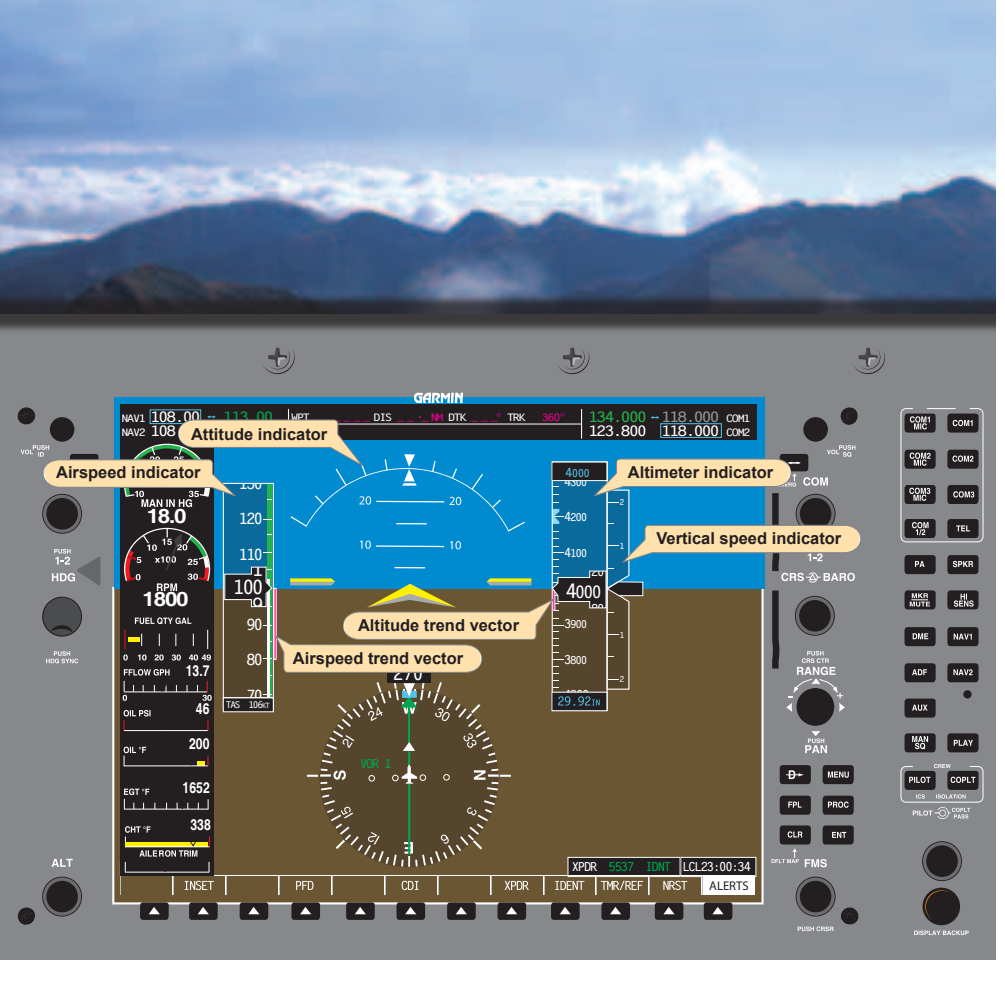
The instruments that directly or indirectly indicate pitch on the primary flight display (PFD) are the attitude indicator, altimeter, vertical speed indicator (VSI), airspeed indicator (ASI), and both airspeed and altitude trend indicators.
Attitude Indicator
The attitude indicator gives the pilot a direct indication of the pitch attitude. The increased size of the attitude display on the EFD system greatly increases situational awareness for the pilot. Most attitude indicators span the entire width of the PFD screen.
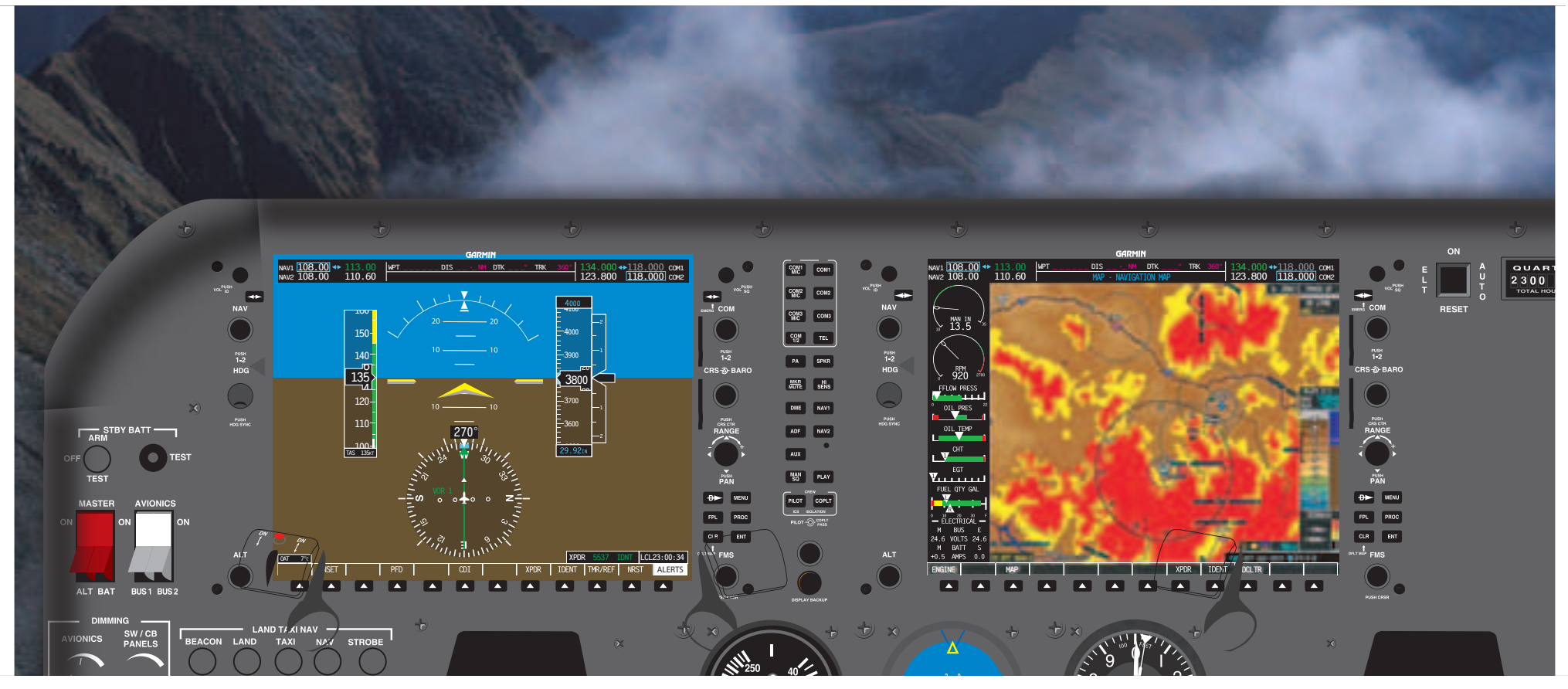
The aircraft pitch attitude is controlled by changing the deflection of the elevator. As the pilot pulls back on the control yoke causing the elevator to rise, the yellow chevron begins to show a displacement up from the artificial horizon line. This is caused by the AHRS unit sensing the changing angle between the longitudinal plane of the earth and the longitudinal axis of the aircraft.
The attitude indicator displayed on the PFD screen is a representation of outside visual cues. Rather than rely on the natural horizon visible during visual flight rules (VFR) flight, the pilot must rely on the artificial horizon of the PFD screen.
During normal cruise airspeed, the point of the yellow chevron (aircraft symbol) is positioned on the artificial horizon. Unlike conventional attitude indicators, the EFD attitude indicator does not allow for manipulating the position of the chevron in relationship to the artificial horizon. The position is fixed and therefore always display the pitch angle as calculated by the AHRS unit.
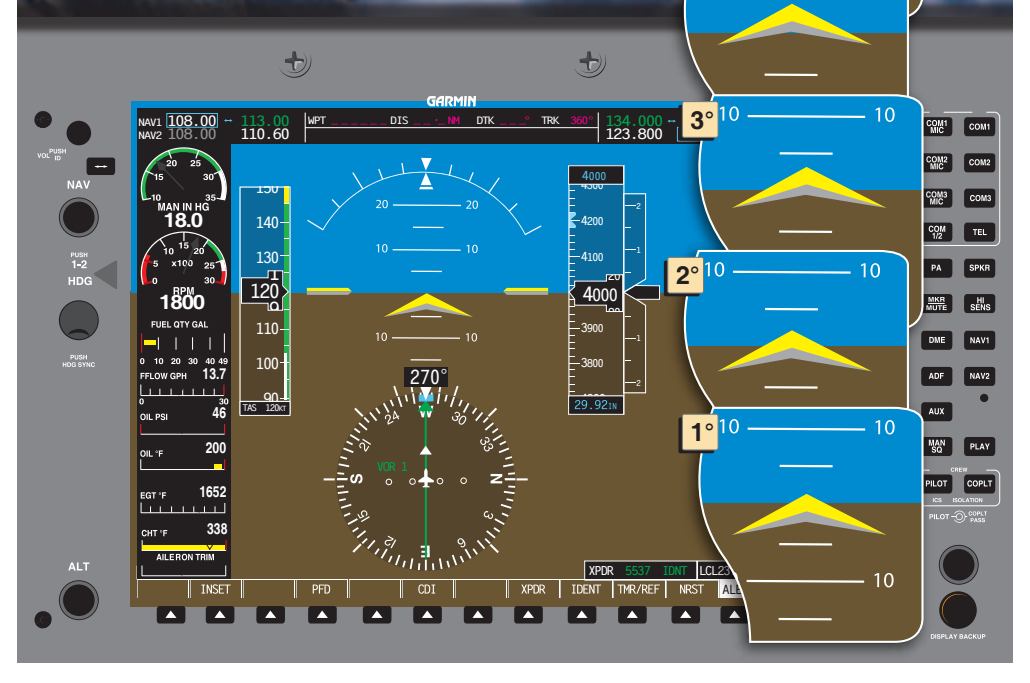
The attitude indicator only shows pitch attitude and does not indicate altitude. A pilot should not attempt to maintain level flight using the attitude indicator alone. It is important for the pilot to understand how small displacements both up and down can affect the altitude of the aircraft. To achieve this, the pilot should practice increasing the pitch attitude incrementally to become familiar with how each degree of pitch changes the altitude. [Figures 7-50 and 7-51] In both cases, the aircraft will slow and gain altitude.