
Chapter 4
Operations
Deployment and Inflation Characteristics
Main canopies have changed dramatically over the last several years and, consequently, different opening problems have emerged. Some canopies are inherently hard openers, while others are inherently slow openers. Accuracy canopies, with their thick airfoils and large overhanging topskins, fall into the first category, while thinner airfoils, with flatter trim and baffled leading edges, tend to fall into the latter.
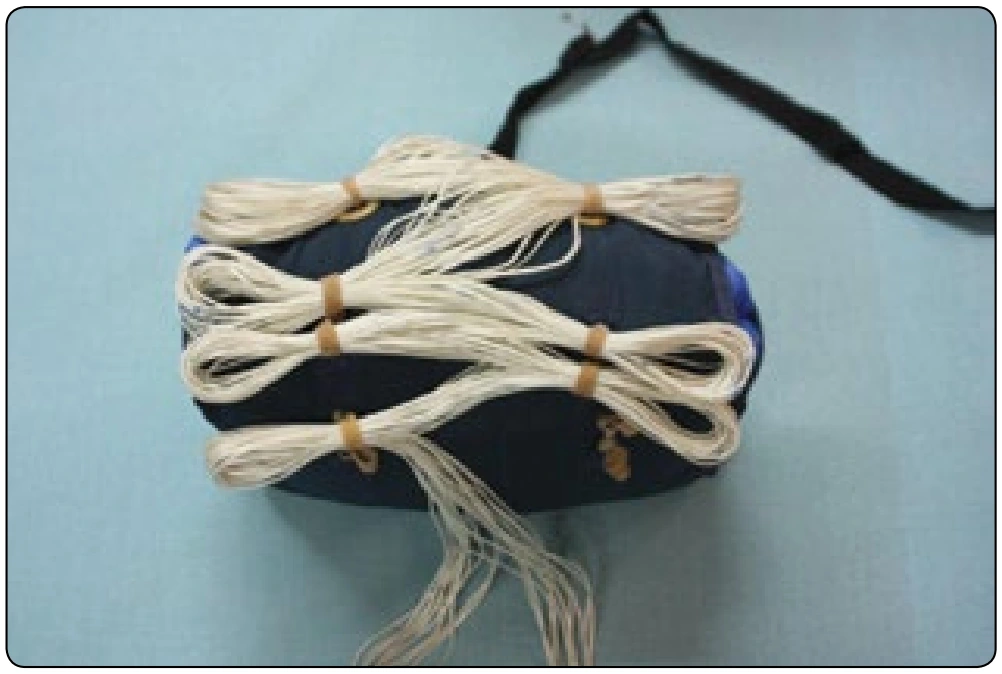
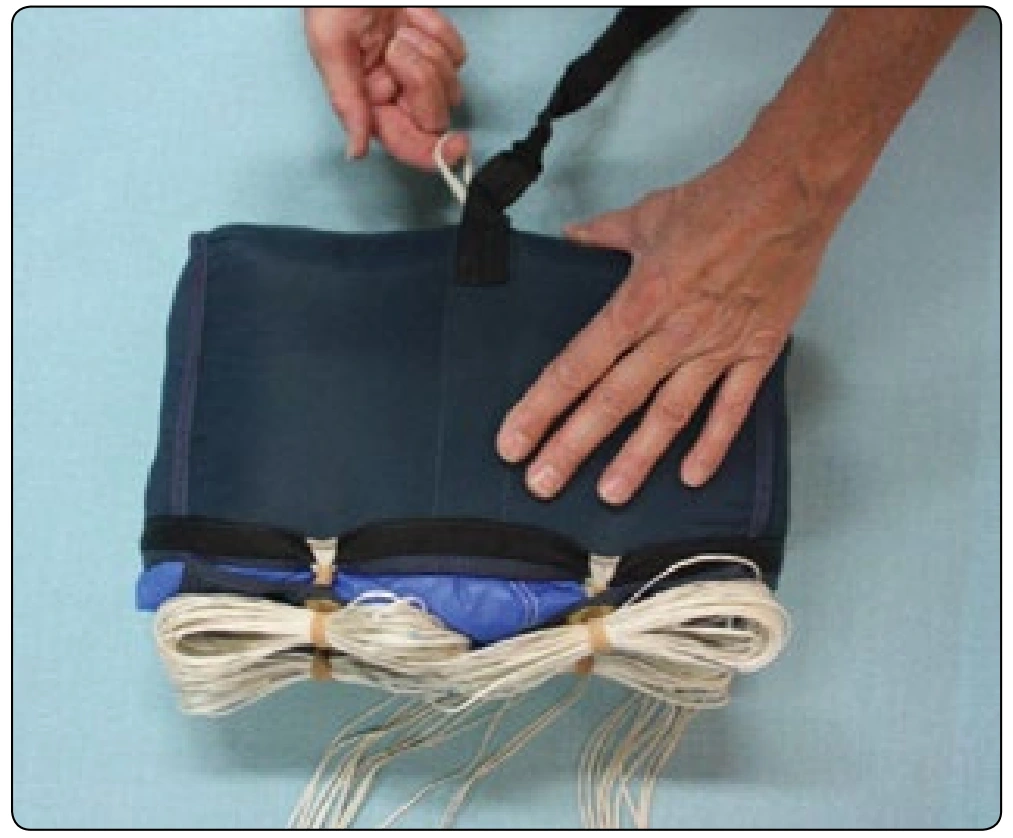
One of the most common problems encountered is that of hard openings. Line strip or line dump is the leading cause of hard openings. This occurs when inadequately-stowed lines come off of the bag all at once instead of releasing one line bight at a time in an orderly fashion, and subsequently the canopy is allowed to inflate prior to line stretch resulting in sometimes an explosive opening. Securing the lines so that it takes approximately 12 pounds of force to release each bight is accomplished with a proper stow band and balancing the weight and mass of the lines by placing 50 percent of the line weight and mass on the mid-section of the bag and 25 percent of the weight and mass on each side of the bag. This alleviates the problem of line strip.
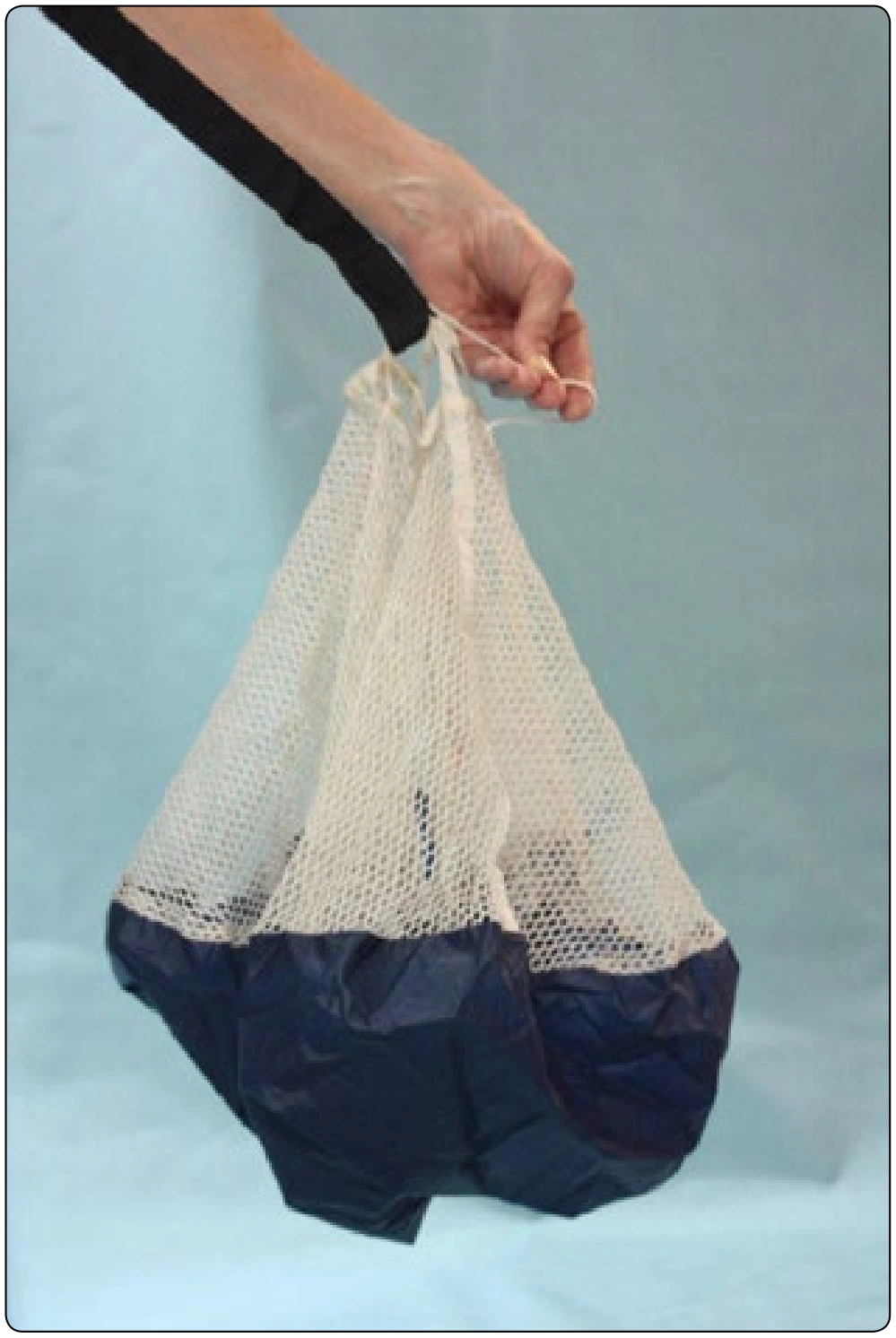
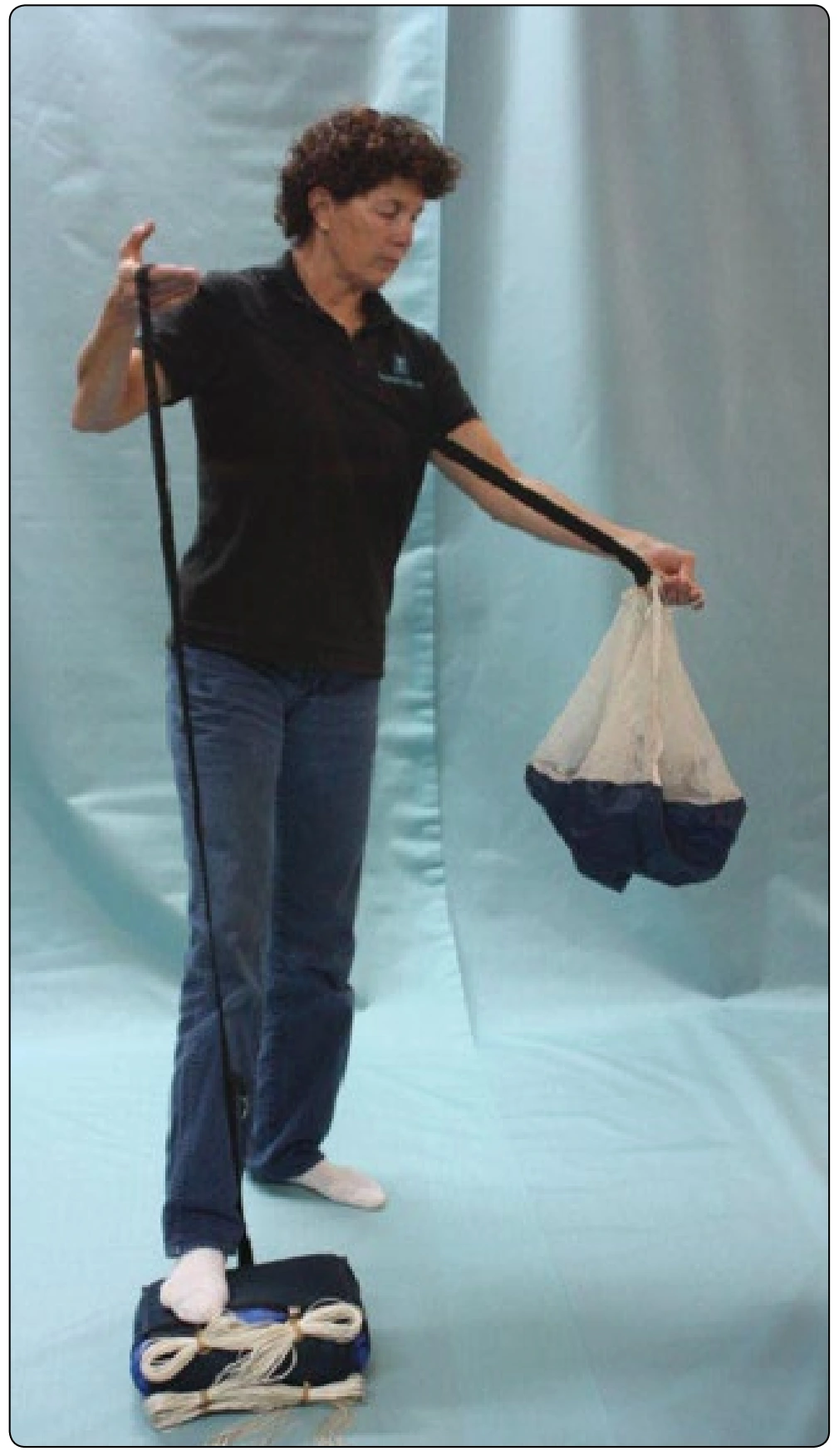
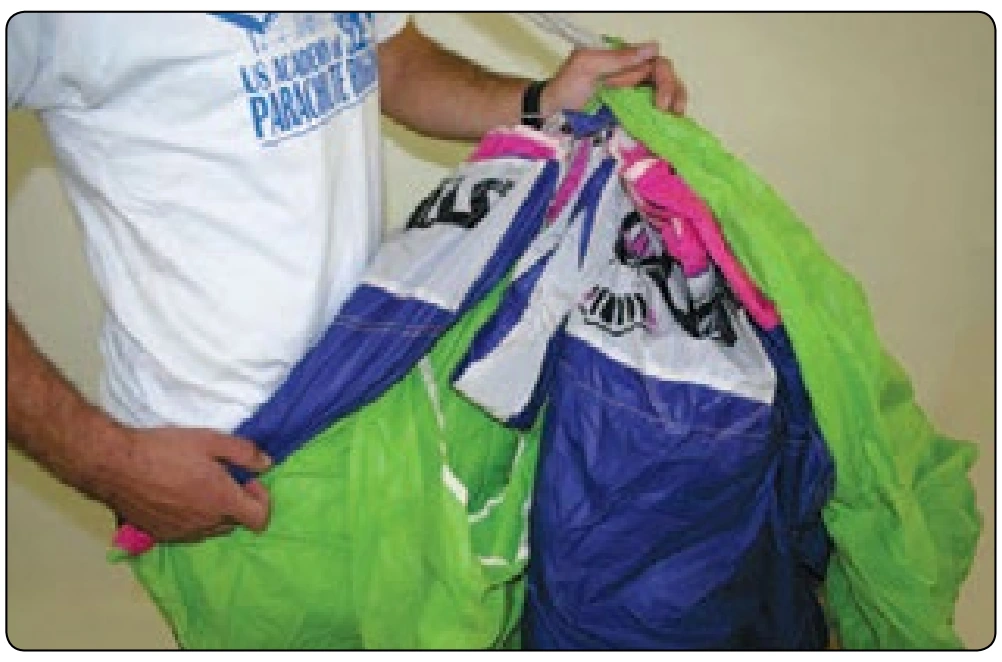
There are other methods employed to reduce hard openings, such as rolling the nose of the canopy to delay the initial inflation process as the leading edge unfurls. This rolling technique varies from a single roll to several rolls. [Figure 4-36] If this does not solve the opening problem, riggers should contact the manufacturer for advice. Most manufacturers are very cooperative and have considerable expertise in working with their products.
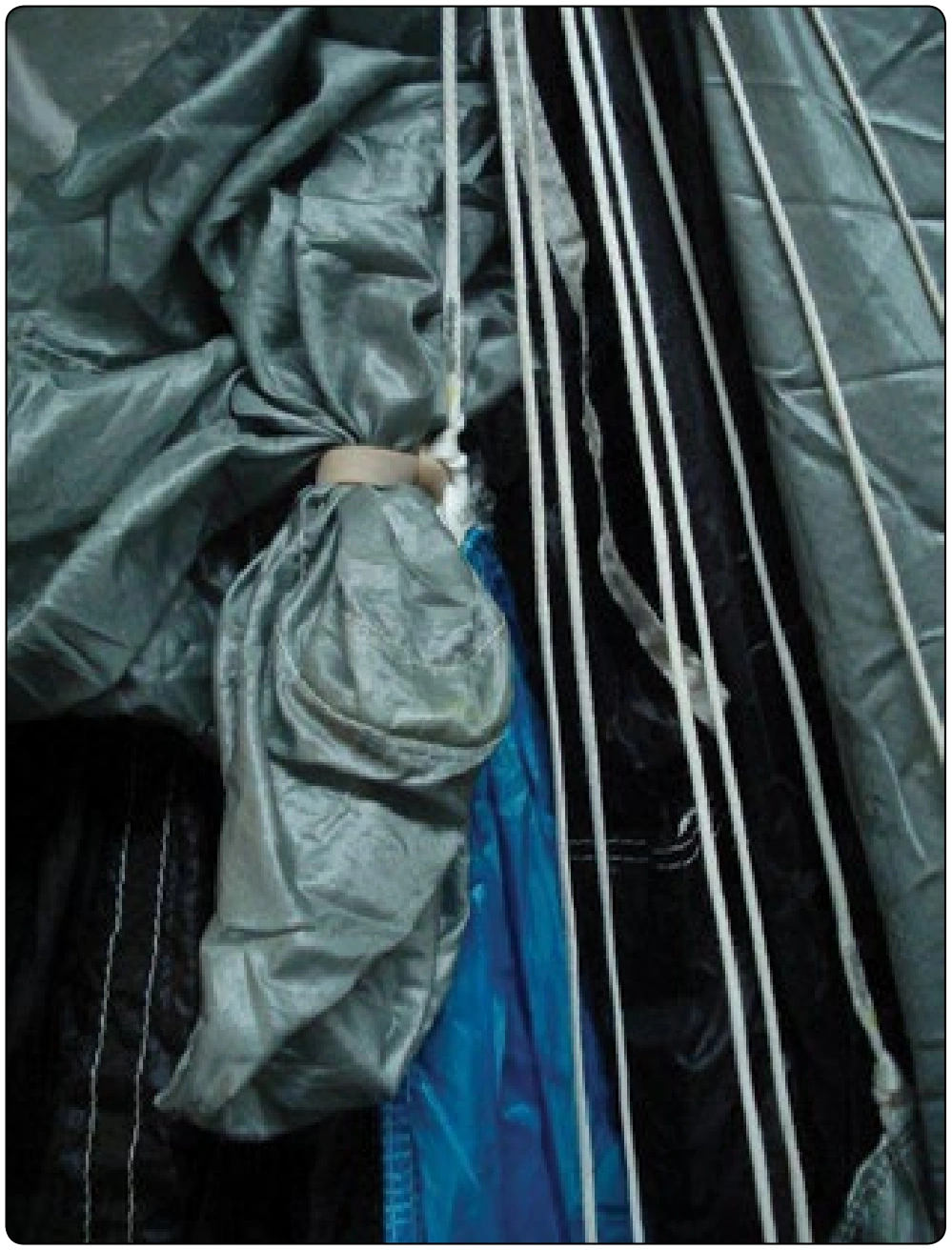
The manufacturer may recommend modifying the slider size or deployment brake settings. Of these options, the easiest to do is to change the brake setting. Reducing the brake setting results in less pressure on the canopy during opening, thereby reducing the opening force. The negative effect of reducing the brake setting is an increase in opening surge. The new brake setting must find the balance of these results that best fit the user. If changing the brake setting does not work, then the rigger may wish to increase the size of the slider to slow the openings. This usually means replacing the slider with a larger one. This has the effect of increasing the drag on the slider and restricting the canopy inflation. Another effective method of preventing hard openings is to install a 2-inch diameter rubber band on the center B or C line attachment tab and stowing the apex of the slider in a single wrap of that band. [Figure 4-37] The jumpers’ airspeed also has a significant effect on opening shock. Jumpers should make a conscious effort to slow down before putting out their pilot chute, and then assume a slightly head high attitude in preparation for opening.
As canopies age and accumulate substantial jumps on them, many begin to develop slow openings, commonly known as “sniveling.” If the canopy was originally packed with the nose rolled, reducing the number of rolls may speed up the openings. However, many times the slow openings are due to other causes. Probably the main reason for canopies developing slow openings is increased porosity that occurs with frequent use. It is especially noticeable on canopies that have a “lip” or a baffled nose. These particular design features cause a canopy to open slower for softer openings, which is a desirable characteristic, but as the canopy fabric wears and permeability increases, the openings may get too slow.
The effect on fabric that originally had a permeability of 0–3 cubic feet per minute (CFM) or 0–5 CFM, such as PIA-C-44378, may not be as dramatic. With these canopies, pulling down the tail by deepening the brake setting speeds up the inflation of the canopy. The rigger must be careful not to set the brakes so deeply as to place the canopy in a stall during opening. If this does not work, then decreasing the size of the slider or the fabric type of the slider may help speed up the openings. The size and condition of the pilot chute may also contribute to the perceived speed of opening.
Another cause is when the canopy gets out of trim due to the stretch of the suspension lines or shrinkage of steering/ brake lines. The rigger should check the trim of the canopy against the manufacturer’s specifications and either re-trim the canopy or re-line it. This may have a pronounced effect of improving the openings, as well as the flying characteristics.
Main Pilot Chute
Hand deploy pilot chutes are made from either the PIA-C-44378 (0–3 CFM) (formerly known as F-111 which is a proprietary brand name that is no longer manufactured. Currently 0-3 CFM is commonly referred to as Silktique and Exazta-Chute) fabric or zero porosity (0 CFM) fabric. The PIA-C-44378 fabric begins as a very low-porosity fabric but, as it is used, the permeability increases. When this happens, the drag of the pilot chute decreases. Consequently, the ability of the pilot chute to “lift” the weight of the canopy decreases and the speed of the opening is affected. Experience has shown that pilot chutes made from this type of fabric exhibit a decrease in performance at around 500 jumps under normal use. Pilot chutes made from the ZP fabric last considerably longer than those made from 0–3 CFM fabric. However, there has been some disagreement concerning the use of the two different fabrics in pilot chutes. One canopy manufacturer advocates the use of F-111-type fabric only. They believe the ZP fabric contributes to hard openings. Most parachutists like ZP pilot chutes because they last longer. The size of the pilot chute has a direct correlation to the type of opening experienced. In the early days of hand deploy chutes, a 36 inch 0–3 CFM pilot chute was standard on most systems.
As the canopies became smaller and lighter, pilot chutes became smaller as well. Today, 24-, 26-, 28-, and 30-inch pilot chutes are all common.
Several factors dictate the size of the pilot chute used. The first is the weight of the canopy. Another factor is the main container closing configuration. Some systems are designed to hold the deployment bag so securely that it requires more drag to extract it from the container. This type may require a larger pilot chute than the type of container that allows unrestricted extraction of the bag. This same problem can develop when an individual packs an oversized main canopy into the main container. If a larger deployment bag is used to hold the additional volume and the bag is forcibly stuffed into the container, the bag can be restricted from being pulled smoothly from the container. If the pilot chute is too small, a pilot chute in tow can result. If the parachutist puts a larger pilot chute on the system, the bag can be extracted from the container, but the increased size of the pilot chute contributes to increased snatch force during the opening sequence. This results in perceived hard openings.
It should be noted that deployment bags are matched dimensionally to containers—not to canopies. If the tray of your container is 12 inches wide, 7 inches long, and 5 inches thick, the bag should also be those dimensions. Forcing a larger bag into the container overstresses the flaps, grommets, stiffeners, and some loop anchors. Conversely, if you put a smaller canopy than was originally intended into the container, you should use the same bag and pack the canopy as wide and “fluffy” as possible. In other words, do not squish all of the air out of the pack job as you normally would. The main closing loop should be appropriately shortened.
Using a smaller bag than the container was built for can result in unsafe conditions as well. In the event of a premature container opening, the bag may float out before the jumper has an opportunity to deploy the pilot chute. Some friction is desirable so that the bag rotates out of the container in the proper sequence—bridle up, lines down. There is an exception to this tenet for wingsuiters, who essentially open in a track. So, the size of the pilot chute and, to some extent, the deployment bag can have considerable effect on the opening of the main parachute.