
Chapter 3
Identifying Hazards & Associated Risks
A numerical FRAT lists different hazards and an associated number, which indicates the significance of each hazard. The pilot selects the relevant hazards, and derives a total score. Typically, the score falls into three ranges. If the total score is below a certain minimum, the FRAT indicates low risk. If it is in an intermediate range, the pilot is advised to “exercise caution.” If the score is above an upper threshold, the FRAT indicates danger. [Figure 3-6]
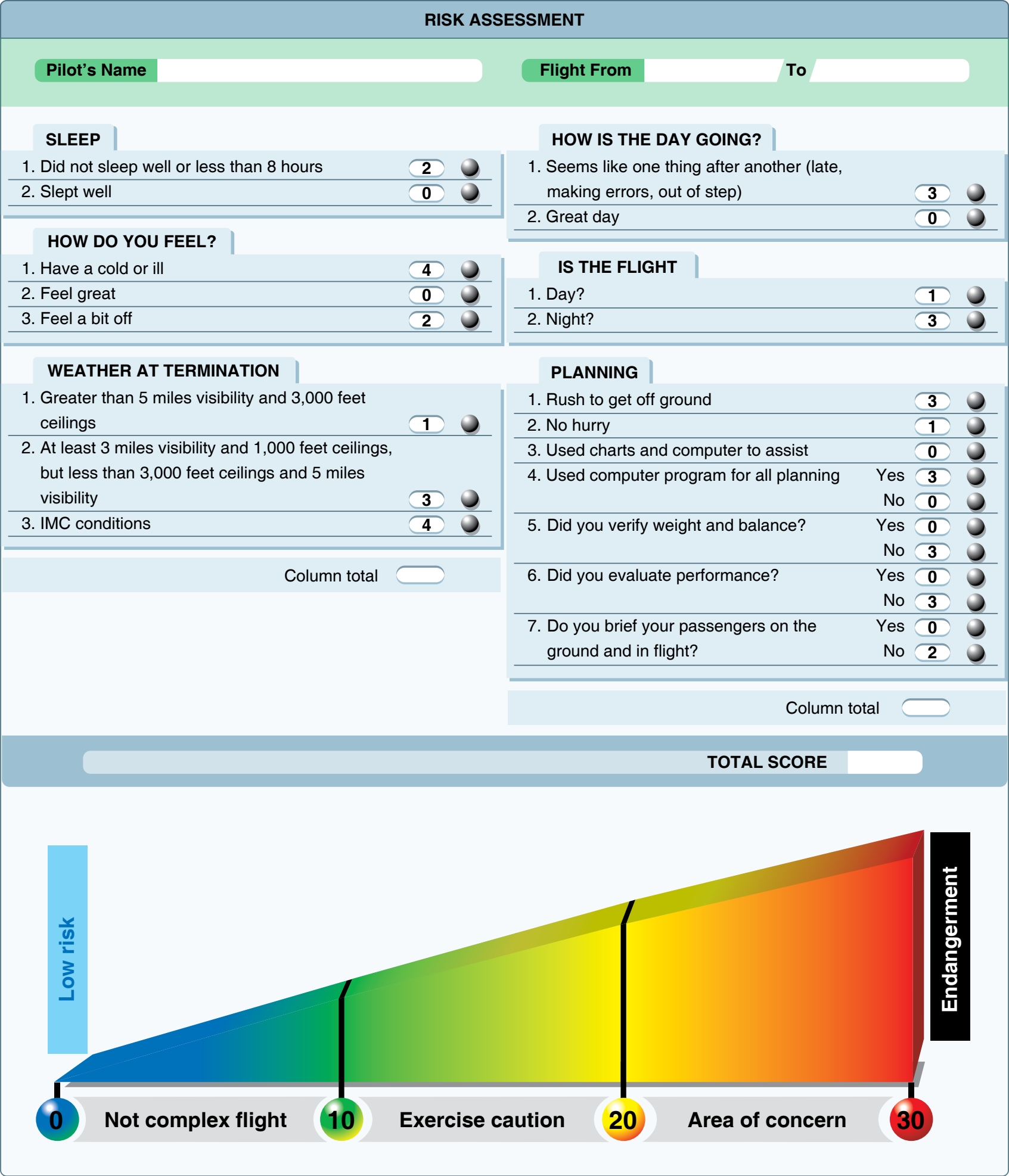
The FAA provides a numerical FRAT [here](https://www.faasafety.gov/gslac/ALC/lib_categoryview.aspx?categoryId=31). While this type of FRAT is easy to use, it has several drawbacks, including:
- The form may not cover all the hazards for a particular flight.
- The range of scores for each risk level may appear arbitrary, leading a pilot to question the results.
- The form does not encourage the pilot to analyze each hazard. For example, what is the likelihood the condition will lead to an accident and what is the potential accident severity?
- The form may indicate an overall low level of risk, leading the pilot to ignore the implications of a particular hazard.
Narrative FRATs
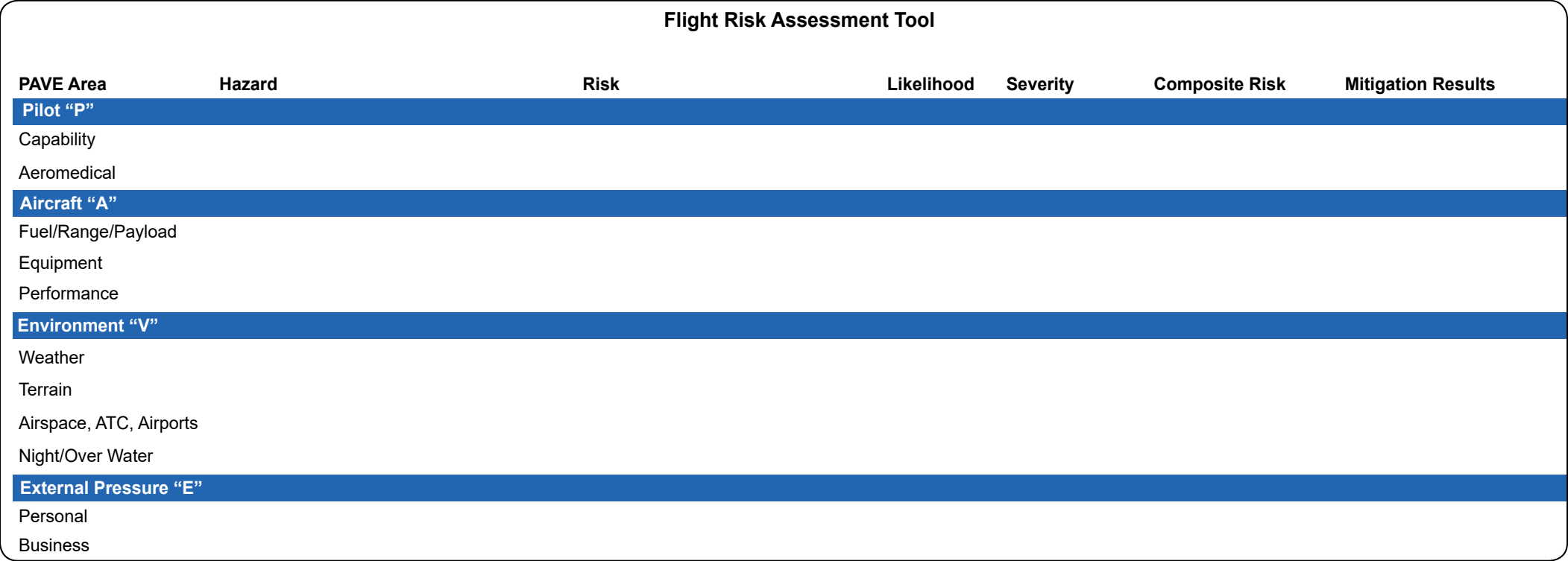
This type of FRAT asks the user to identify hazards and associate each hazard with risk. While taking more time to complete, it addresses many of the disadvantages of a numerical FRAT. After identifying the hazards, the process includes a thorough analysis and management of each risk.
The following example of a narrative FRAT has the pilot determine the likelihood and severity for each hazard identified using the PAVE checklist [Figure 3-6]. After further analysis, the pilot can determine how to manage each risk. This concept will be explored further in the next chapter.
Case Study
One way to understand the risk management process is to put it in a real-world context using a case study. The following example will be used in this chapter, as well as Chapters 4 and 5, to illustrate a process to identify hazards, assess the associated risks, and mitigate the risks as needed.
Background and Setting
It is early on Friday, July 1, and Tricia just finished a successful week of consulting for clients in Portland, Boise, Dallas, and Albuquerque. She flew to these locations from her home base in Santa Rosa, California (KSTS) using her single-engine airplane. She had planned to return directly to Santa Rosa, but yesterday evening, her friends from Santa Rosa, Matt and Martha Smith, invited her to spend the weekend in Durango, Colorado where they have a condominium. She gladly accepted their invitation because she would enjoy seeing them.
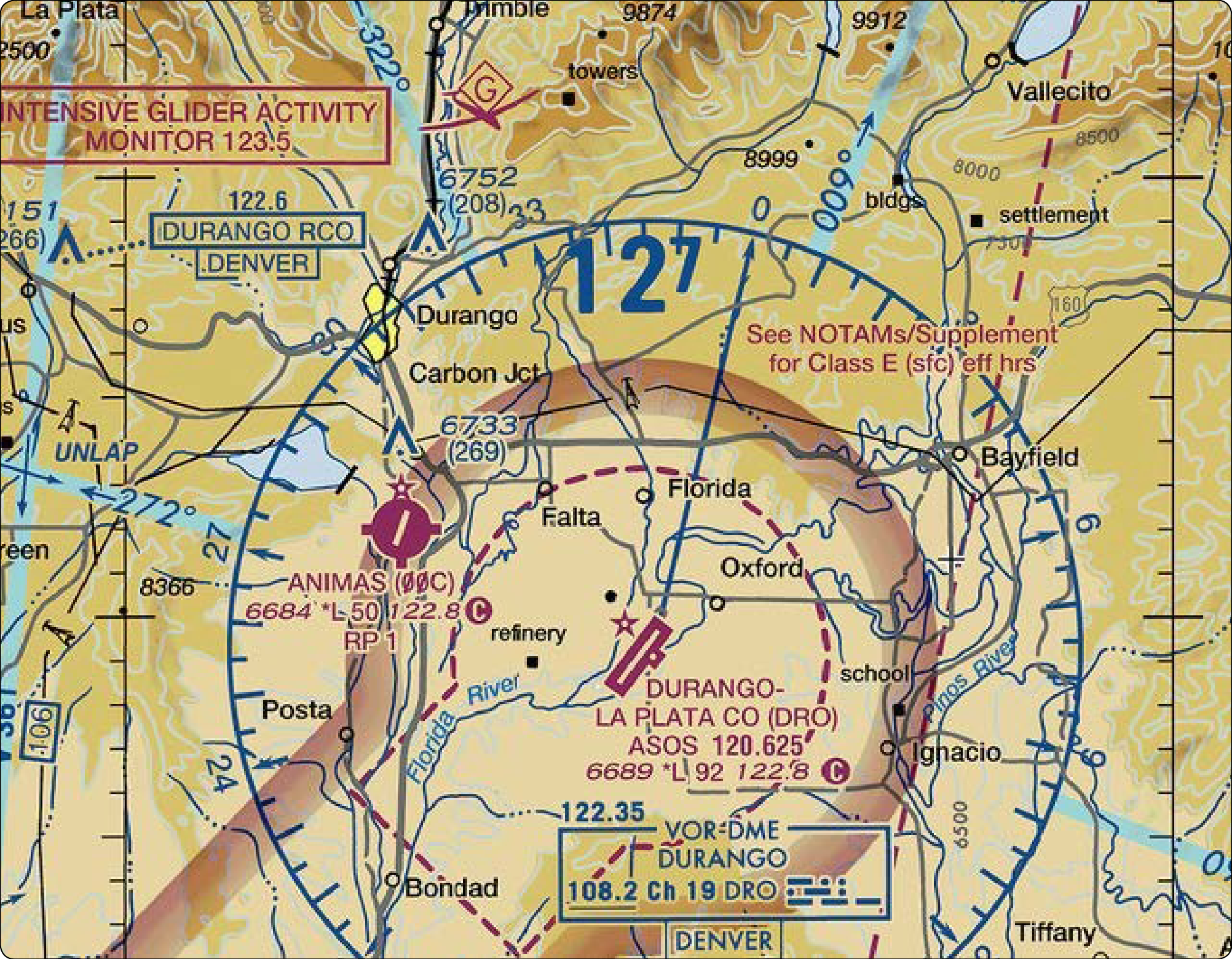
The flight from Albuquerque to Durango during the day on Friday goes smoothly. Tricia lands at the Animas Air Park (00C), rather than the Durango-La Plata County Airport (KDRO) because the Smith’s condo is less than a mile from Animas Air Park, toward town. Figure 3-8 shows a sectional chart excerpt from the Durango area.
Tricia and the Smiths are enjoying the warm-weather weekend with rafting, cycling, and hiking as featured activities. The Smiths are well-established in the Durango social scene, and the three friends go to parties on Friday and Saturday night, with another one scheduled for Sunday night. Finally, on Monday, July 4, there will be a city-sponsored Independence Day celebration where the Smiths will officiate.
It is now late afternoon on Sunday. Tricia and the Smiths are back in their condo relaxing and discussing the weekend. Coincidentally, both Tricia and Martha Smith just received urgent emails from their separate home offices in Santa Rosa, CA, alerting them to critical meetings that are scheduled for Tuesday afternoon–Tricia’s at 4 pm and Martha’s at 3 pm. Matt tries to book airline tickets from Durango to Santa Rosa for Tuesday morning, and with a worried look, he announces that there are no airline seats available until Wednesday, at the earliest.
Martha Smith then asks Tricia, “Would you be willing to fly us home in your airplane on Tuesday morning? This would allow us all to enjoy the Monday celebration and the party Monday night before taking off early on Tuesday.” Tricia replies, “I need to review the weather and do some other planning first, and we can all meet in a couple of hours.”
Tricia goes back to her room and begins her analysis. First, she looks at the route that she might take home. Originally, she planned a direct VFR flight back to Santa Rosa, a nonstop flight of 711 nautical miles, as depicted in the sectional chart excerpt in Figure 3-9.
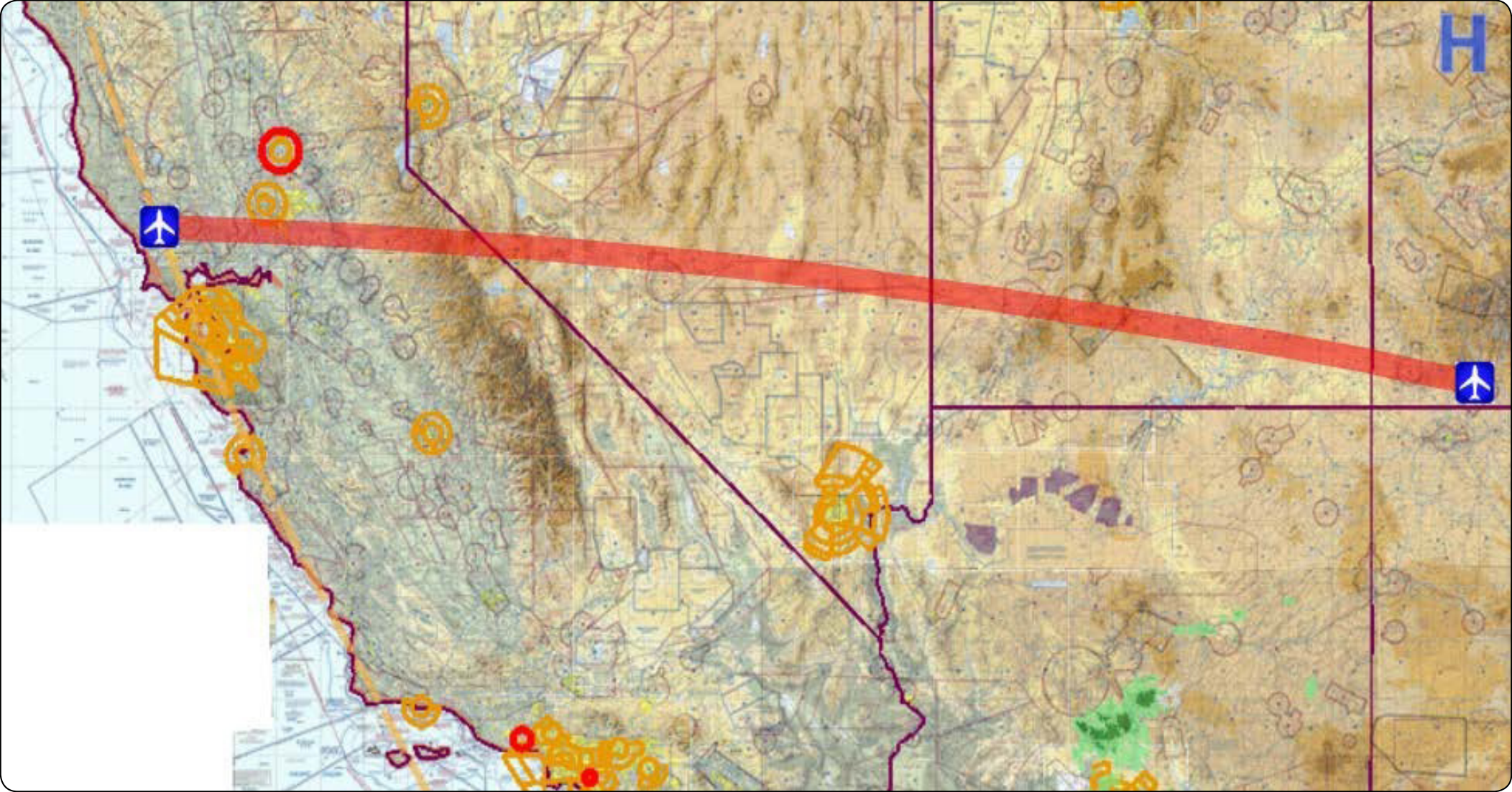
Tricia makes a quick analysis and figures she can fly this trip nonstop in just under five hours, with 6 hours and 45 minutes of endurance with full tanks. She then evaluates the weather and immediately foresees some challenges.