Chapter 13
Aircraft Landing Gear Systems
Loosening the Tire from the Wheel Rim
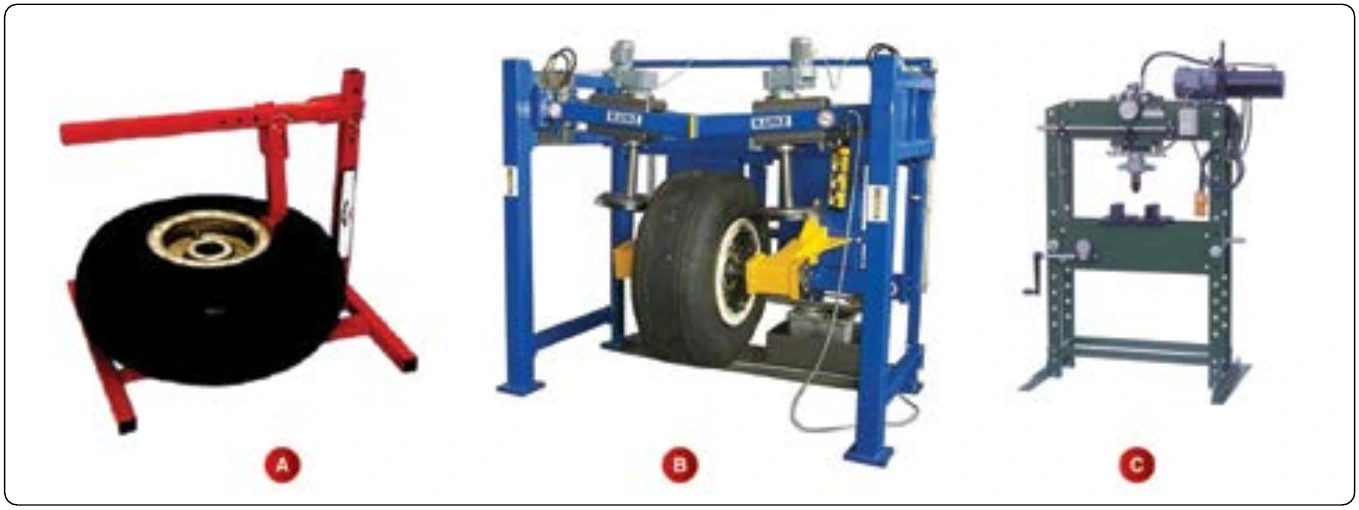
After inflation and usage, an aircraft tire has a tendency to adhere to the wheel, and the bead must be broken to remove the tire. There are mechanical and hydraulic presses designed for this purpose. In the absence of a device specifically made for the job, an arbor press can be used with patience working sequentially around the wheel as close as possible to the bead. [Figure 13-64] As stated above, there should be no air pressure in the tire while it is being pressed off of the wheel. Never pry a tire off of the rim with a screwdriver or other device. The wheels are relatively soft. Any nick or deformation causes a stress concentration that can easily lead to wheel failure.
Disassembly of the Wheel
Disassembly of the wheel should take place in a clean area on a flat surface, such as a table. Remove the wheel bearing first and set aside for cleaning and inspecting. The tie bolts can then be removed. Do not use an impact tool to disassemble the tie bolts. Aircraft wheels are made of relatively soft aluminum and magnesium alloys. They are not designed to receive the repeated hammering of an impact tool and will be damaged if used.
Cleaning the Wheel Assembly
Clean the wheel halves with the solvent recommended by the wheel manufacturer. Use of a soft brush helps this process. Avoid abrasive techniques, materials, and tools, such as scrapers, capable of removing the finish off of the wheel. Corrosion can quickly form and weaken the wheel if the finish is missing in an area. When the wheels are clean, they can be dried with compressed air.
Cleaning the Wheel Bearings
The bearings should be removed from the wheel to be cleaned with the recommended solvent, such as varsol, naptha, or Stoddard® solvent. Soaking the bearings in solvent is acceptable to loosen any dried-on grease. Bearings are brushed clean with a soft bristle brush and dried with compressed air. Never rotate the bearing while drying with compressed air. The high-speed metal to metal contact of the bearing rollers with the race causes heat that damages the metal surfaces. The bearing parts could also cause injury should the bearing come apart. Always avoid steam cleaning of bearings. The surface finish of the metals will be compromised leading to early failure.
Wheel Bearing Inspection
Once cleaned, the wheel bearing is inspected. There are many unacceptable conditions of the bearing and bearing cup, which are grounds for rejection. In fact, nearly any flaw detected in a bearing assembly is likely to be grounds for replacement.
Common conditions of a bearing that are cause for rejection are as follows:
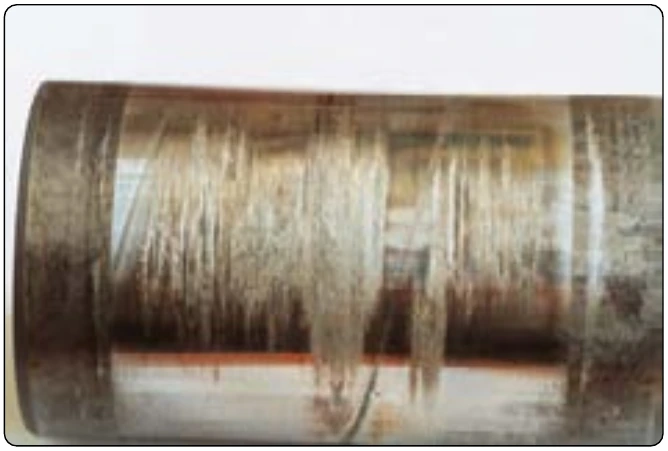
Galling—caused by rubbing of mating surfaces. The metal gets so hot it welds, and the surface metal is destroyed as the motion continues and pulls the metal apart in the direction of motion. [Figure 13-65]
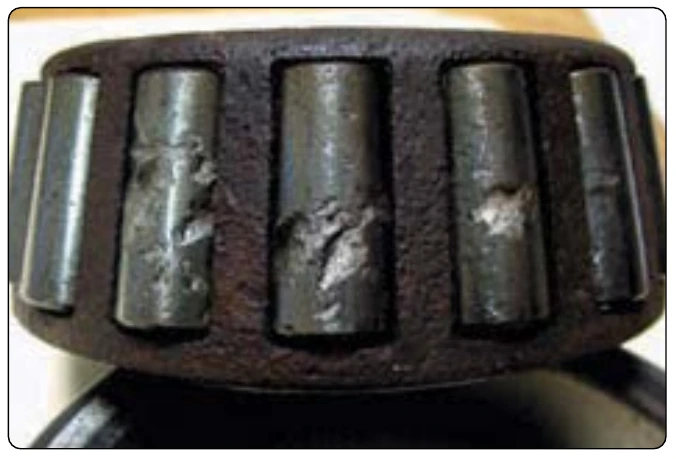
Spalling—a chipped away portion of the hardened surface of a bearing roller or race. [Figure 13-66]
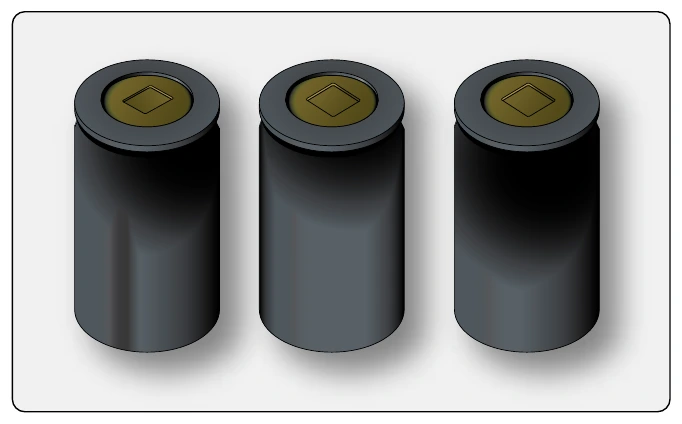
Overheating—caused by lack of sufficient lubrication results in a bluish tint to the metal surface. The ends of the rollers shown were overheated causing the metal to flow and deform, as well as discolor. The bearing cup raceway is usually discolored as well. [Figure 13-67]
Brinelling—caused by excessive impact. It appears as indentations in the bearing cup raceways. Any static overload and caused by water that has gotten into the bearing. It is the first stage of deeper corrosion that follows. [Figure 13-70]