
Chapter 13
Aircraft Landing Gear Systems
The technician should follow airframe and tire manufacturer instructions to determine if a tire is repairable. Many example guidelines have also been given in this section. Nearly all tire repairs must be made at a certified tire repair facility equipped to perform the approved repair. Bead damage, ply separation, and sidewall cord exposure all require that the tire be scrapped. Inner liner condition on tubeless tires is also critical. Replacing the tube in a tube-type tire is performed by the technician as are mounting and balancing all types of aircraft tires.
Aircraft tires are very expensive. They are also extremely durable. The effective cost of a tire over its life can be reduced by having the tread replaced while the carcass is still sound, and injuries are within repairable limits. Federal Aviation Administration (FAA) certified tire retread repair stations, often the original equipment manufacturer (OEM), do this work. The technician inspects a tire to pre-qualify it for retread so that the cost of shipping it to the retread repair facility is not incurred if there is no chance to retread the tire. The tire retreader inspects and tests every tire to a level beyond the capability of the hangar or line technician. Shearography, an optical nondestructive testing method that provides detailed information about the internal integrity of the tire, is used by tire retread repair facilities to ensure a tire carcass is suitable for continued service.
Tires that are retreaded are marked as such. They are not compromised in strength and give the performance of a new tire. No limits are established for the number of times a tire can be retreaded. This is based on the structural integrity of the tire carcass. A well maintained main gear tire may be able to be retreaded a handful of times before fatigue renders the carcass un-airworthy. Some nose tires can be retread nearly a dozen times.
Tire Storage
An aircraft tire can be damaged if stored improperly. A tire should always be stored vertically so that it is resting on its treaded surface. Horizontal stacking of tires is not recommended. Storage of tires on a tire rack with a minimum 3–4-inch flat resting surface for the tread is ideal and avoids tire distortion.
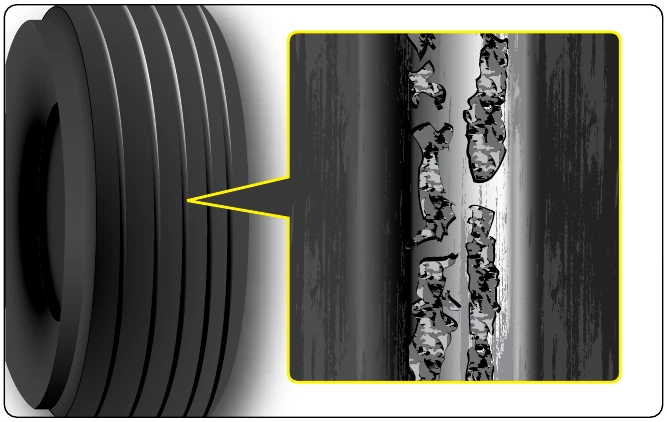
If horizontal stacking of tires is necessary, it should only be done for a short time. The weight of the upper tires on the lower tires cause distortion possibly making it difficult for the bead to seat when mounting tubeless tires. A bulging tread also stresses rib grooves and opens the rubber to ozone attack in this area. [Figure 13-152] Never stack aircraft tires horizontally for more than 6 months. Stack no higher than four tires if the tire is less than 40-inches in diameter and no higher than three tires if greater than 40-inches in diameter. The environment in which an aircraft tire is stored is critical. The ideal location in which to store an aircraft tire is cool, dry, and dark, free from air currents and dirt.
An aircraft tire contains natural rubber compounds that are prone to degradation from chemicals and sunlight. Ozone (O3) and oxygen (O2) cause degradation of tire compounds. Tires should be stored away from strong air currents that continually present a supply of one or both of these gases. Fluorescent lights, mercury vapor lights, electric motors, battery chargers, electric welding equipment, electric generators, and similar shop equipment produce ozone and should not be operated near aircraft tires. Mounted inflated tires can be stored with up to 25 percent less pressure than operating pressure to reduce vulnerability from ozone attacks. Sodium vapor lighting is acceptable. Storage of an aircraft tire in the dark is preferred to minimize degradation from ultraviolet (UV) light. If this is not possible, wrap the tire in dark polyethylene or paper to form an ozone barrier and to minimize exposure to UV light.
Common hydrocarbon chemicals, such as fuels, oils, and solvents, should not contact a tire. Avoid rolling tires through spills on the hangar or shop floor and be sure to clean any tire immediately if contaminated. Dry the tire and store all tires in a dry place away from any moisture, which has a deteriorating effect on the rubber compounds. Moisture with foreign elements may further damage the rubber and fabric of a tire. Dirty areas must be avoided.
Tires are made to operate in a wide range of temperatures. However, storage should be at cool temperatures to minimize degradation. A general range for safe aircraft tire storage is between 32 °F and 104 °F. Temperatures below this are acceptable but higher temperatures must be avoided.
Aircraft Tubes
Many aircraft tires accept a tube inside to contain the inflation air. Tube-type tires are handled and stored in similar fashion as tubeless tires. A number of issues concerning the tubes themselves must be addressed.
Tube Construction & Selection
Aircraft tire tubes are made of a natural rubber compound. They contain the inflation air with minimal leakage. Unreinforced and special reinforced heavy-duty tubes are available. The heavy-duty tubes have nylon reinforcing fabric layered into the rubber to provide strength to resist chafing and to protect against heat such as during braking.
Tubes come in a wide range of sizes. Only the tube specified for the applicable tire size must be used. Tubes that are too small stress the tube construction.
Tube Storage & Inspection
An aircraft tire tube should be kept in the original carton until put into service to avoid deterioration through exposure to environmental elements. If the original carton is not available, the tube can be wrapped in several layers of paper to protect it. Alternately, for short time periods only, a tube may be stored in the correct size tire it is made for while inflated just enough to round out the tube. Application of talc to the inside of the tire and outside of the tube prevents sticking. Remove the tube and inspect it and the tire before permanently mounting the assembly. Regardless of storage method, always store aircraft tubes in a cool, dry, dark place away from ozone producing equipment and moving air.
When handling and storing aircraft tire tubes, creases are to be avoided. These weaken the rubber and eventually cause tube failure. Creases and wrinkles also tend to be chafe points for the tube when mounted inside the tire. Never hang a tube over a nail or peg for storage.
An aircraft tube must be inspected for leaks and damage that may eventually cause a leak or failure. To check for leaks, remove the tube from the tire. Inflate the tube just enough to have it take shape but not stretch. Immerse a small tube in a container of water and look for the source of air bubbles. A large tube may require that water be applied over the tube. Again, look for the source of bubbles. The valve core should also be wetted to inspect it for leaks.
There is no mandatory age limit for an aircraft tire tube. It should be elastic without cracks or creases in order to be consider serviceable. The valve area is prone to damage and should be inspected thoroughly. Bend the valve to ensure there are no cracks at the base where it is bonded to the tire or in the area where it passes through the hole in the wheel rim. Inspect the valve core to ensure it is tight and that it does not leak.