
Chapter 4
Aircraft Metal Structural Repair
Hex Nut & Wing Nut Temporary Sheet Fasteners
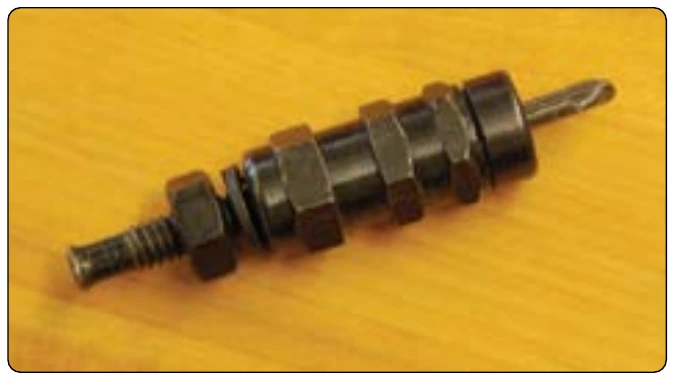
Hex nut and wing nut fasteners are used to temporarily fasten sheets of metal when higher clamp up pressure is required. [Figure 4-73] Hex nut fasteners provide up to 300 pounds of clamping force with the advantage of quick installation and removal with a hex nut runner. Wing nut sheet metal fasteners, characterized by wing shaped protrusions, not only provide a consistent clamping force from 0 to 300 pounds, but the aircraft technician can turn and tighten these fasteners by hand. Cleco hex nut fasteners are identical to Cleco wing nut fasteners, but the Cleco hex nut can be used with pneumatic Cleco installers.
Aluminum Alloys
Aluminum alloys are the most frequently encountered type of sheet metal in aircraft repair. AC 43.13-1 Chapter 4, Metal Structure, Welding, and Brazing; Section 1, Identification of Metals (as revised) provides an in-depth discussion of all metal types. This section describes the aluminum alloys used in the forming processes discussed in the remainder of the chapter.
In its pure state, aluminum is lightweight, lustrous, and corrosion resistant. The thermal conductivity of aluminum is very high. It is ductile, malleable, and nonmagnetic. When combined with various percentages of other metals (generally copper, manganese, and magnesium), aluminum alloys that are used in aircraft construction are formed. Aluminum alloys are lightweight and strong. They do not possess the corrosion resistance of pure aluminum and are usually treated to prevent deterioration. Alclad™ aluminum is an aluminum alloy with a protective cladding of aluminum to improve its corrosion resistance.
To provide a visual means for identifying the various grades of aluminum and aluminum alloys, aluminum stock is usually marked with symbols such as a Government Specification Number, the temper or condition furnished, or the commercial code marking. Plate and sheet are usually marked with specification numbers or code markings in rows approximately five inches apart. Tubes, bars, rods, and extruded shapes are marked with specification numbers or code markings at intervals of three to five feet along the length of each piece.
The commercial code marking consists of a number that identifies the particular composition of the alloy. Additionally, letter suffixes designate the basic temper designations and subdivisions of aluminum alloys.
The aluminum and various aluminum alloys used in aircraft repair and construction are as follows:
- Aluminum designated by the symbol 1100 is used where strength is not an important factor, but where weight economy and corrosion resistance are desired. This aluminum is used for fuel tanks, cowlings, and oil tanks. It is also used for repairing wingtips and tanks. This material is weldable.
- Alloy 3003 is similar to 1100 and is generally used for the same purposes. It contains a small percentage of magnesium and is stronger and harder than 1100 aluminum.
- Alloy 2014 is used for heavy-duty forgings, plates, extrusions for aircraft fittings, wheels, and major structural components. This alloy is often used for applications requiring high strength and hardness, as well as for service at elevated temperatures.
- Alloy 2017 is used for rivets. This material is now in limited use.
- Alloy 2024, with or without Alclad™ coating, is used for aircraft structures, rivets, hardware, machine screw products, and other miscellaneous structural applications. In addition, this alloy is commonly used for heat-treated parts, airfoil and fuselage skins, extrusions, and fittings.
- Alloy 2025 is used extensively for propeller blades.
- Alloy 2219 is used for fuel tanks, aircraft skin, and structural components. This material has high fracture toughness and is readily weldable. Alloy 2219 is also highly resistant to stress corrosion cracking.
- Alloy 5052 is used where good workability, very good corrosion resistance, high fatigue strength, weldability, and moderate static strength are desired. This alloy is used for fuel, hydraulic, and oil lines.
- Alloy 5056 is used for making rivets and cable sheeting and in applications where aluminum comes into contact with magnesium alloys. Alloy 5056 is generally resistant to the most common forms of corrosion.
- Cast aluminum alloys are used for cylinder heads, crankcases, fuel injectors, carburetors, and landing wheels.
- Various alloys, including 3003, 5052, and 1100 aluminum, are hardened by cold working rather than by heat treatment. Other alloys, including 2017 and 2024, are hardened by heat treatment, cold working, or a combination of the two. Various casting alloys are hardened by heat treatment.
- Alloy 6061 is generally weldable by all commercial procedures and methods. It also maintains acceptable toughness in many cryogenic applications. Alloy 6061 is easily extruded and is commonly used for hydraulic and pneumatic tubing.
- Although higher in strength than 2024, alloy 7075 has a lower fracture toughness and is generally used in tension applications where fatigue is not critical. The T6 temper of 7075 should be avoided in corrosive environments. However, the T7351 temper of 7075 has excellent stress corrosion resistance and better fracture toughness than the T6 temper. The T76 temper is often used to improve the resistance of 7075 to exfoliate corrosion.
Structural Fasteners
Structural fasteners, used to join sheet metal structures securely, come in thousands of shapes and sizes with many of them specialized and specific to certain aircraft. Since some structural fasteners are common to all aircraft, this section focuses on the more frequently used fasteners. For the purposes of this discussion, fasteners are divided into two main groups: solid shank rivets and special purpose fasteners that include blind rivets.
Solid Shank Rivet
The solid shank rivet is the most common type of rivet used in aircraft construction. Used to join aircraft structures, solid shank rivets are one of the oldest and most reliable types of fastener. Widely used in the aircraft manufacturing industry, solid shank rivets are relatively low-cost, permanently installed fasteners. They are faster to install than bolts and nuts since they adapt well to automatic, high-speed installation tools. Rivets should not be used in thick materials or in tensile applications, as their tensile strengths are quite low relative to their shear strength. The longer the total grip length (the total thickness of sheets being joined), the more difficult it becomes to lock the rivet.
Riveted joints are neither airtight nor watertight unless special seals or coatings are used. Since rivets are permanently installed, they must be removed by drilling them out, a laborious task.
Description
Before installation, the rivet consists of a smooth cylindrical shaft with a factory head on one end. The opposite end is called the bucktail. To secure two or more pieces of sheet metal together, the rivet is placed into a hole cut just a bit larger in diameter than the rivet itself. Once placed in this predrilled hole, the bucktail is upset or deformed by any of several methods from hand-held hammers to pneumatically driven squeezing tools. This action causes the rivet to expand about 11⁄2 times the original shaft diameter, forming a second head that firmly holds the material in place.
Rivet Head Shape
Solid rivets are available in several head shapes, but the universal (also known as protruding head) and the 100° countersunk head are the most commonly used in aircraft structures. Universal head rivets were developed specifically for the aircraft industry and designed as a replacement for both the round and brazier head rivets. These rivets replaced all protruding head rivets and are used primarily where the protruding head has no aerodynamic significance. They have a flat area on the head, a head diameter twice the shank diameter, and a head height approximately 42.5 percent of the shank diameter. [Figure 4-74]
The countersunk head angle can vary from 60° to 120°, but the 100° has been adopted as standard because this head style provides the best possible compromise between tension/shear strength and flushness requirements. This rivet is used where flushness is required because the rivet is flat-topped and undercut to allow the head to fit into a countersunk or dimpled hole. The countersunk rivet is primarily intended for use when aerodynamics smoothness is critical, such as on the external surface of a high-speed aircraft.