Chapter 7
Repairs, Alterations, and Manufacture
Harness repairs are almost always a major repair. Consequently, they are master rigger work. About the only repairs open to a senior rigger are replacement of ripcord pockets and Velcro®; and replacement of hand tackings for ripcords, comfort pads, 3-ring housings, and other hardware. Major harness repairs are the most critical maintenance operations a rigger can perform on a parachute assembly. Even seemingly innocuous repairs, if done incorrectly, can have fatal consequences. Depending on the type of harness design, repairs to the harness main lift web or leg straps involve major repair or remanufacture.
According to 14 CFR part 65, section 65.129 (e) and (f), “No certificated parachute rigger may – (e) Pack, maintain, or alter a parachute in any manner that deviates from procedures approved by the Administrator or the manufacturer of the parachute; or (f) Exercise the privileges of his certificate and type rating unless he understands the current manufacturer’s instructions for the operation involved...” In other words, because this operation is a major repair, the person doing the work must be a currently certificated Master Parachute Rigger with the appropriate ratings.
In the past, many master riggers felt that they were empowered to undertake almost any task. The attitude was, “We can lift the TSO label, build a new harness, and put the TSO label back on.” This is not the case. Just because an individual has a master rigger license does not mean he or she is qualified to undertake a complex repair.
There are four primary areas of concern that need to be addressed in any repair program. They are as follows:
- Inspection, damage identification, and repair planning
- Teardown and cleanup
- Preparation and reconstruction
- Quality control inspection and recordkeeping
Main risers are components that are subject to extreme wear and tear. The only items that are practical for repair are the 3-ring locking loops and the toggle mounting/Velcro® assembly. Once the webbing begins to show wear, it is more practical to replace than repair them.
The following are repairs found in Section 3, Harness and Risers:
- Chest strap replacement
- Lower leg strap shortening
- Ripcord pocket Velcro® replacement
- Articulated upper leg hardware replacement
- Standard harness main lift web replacement
- Main riser 3-ring locking loop replacement
- Main riser steering toggle Velcro® replacement
Chest Strap Replacement
- Applicable products: Most standard harness configurations
- Description: Replacement of chest strap due to damage or for lengthening
- Authorized repairmen: FAA Master Parachute Rigger
- Materials: E thread—5-cord nylon thread
- Machines: 301 straight stitch—medium duty 7–11 SPI, heavy-duty harness machine—Singer 7–33 or equivalent-stitch length to match the original, and 308 zigzag—medium duty 7–11 SPI
- Equipment: Scissors, seam ripper or scalpel, marking pencil, ruler, hot glue gun, and hot knife
Procedure
This procedure deals with the longer side of the chest strap, usually the left, which is threaded through the chest adapter or through an adjustable V-ring. Replacing the opposite side would mirror this process.
Disassembly
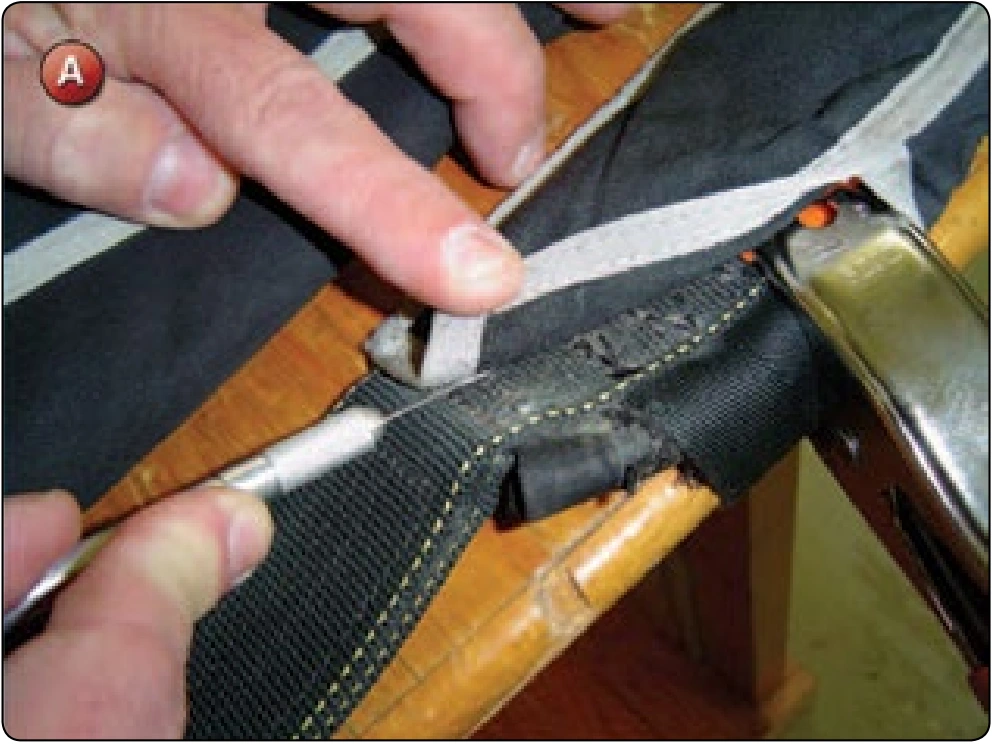
- Examine the chest strap/MLW junction to determine if the backpad needs to be removed from the harness to access the junction. If so, remove the pad from the harness to allow access to the junction. [Figure A]
- Many harnesses have the reserve ripcord housing located on the left side. The housing needs to be disconnected at this location. It is usually secured to a loop located at the chest strap junction. During the replacement process, this loop is removed and may be reused if in good condition.
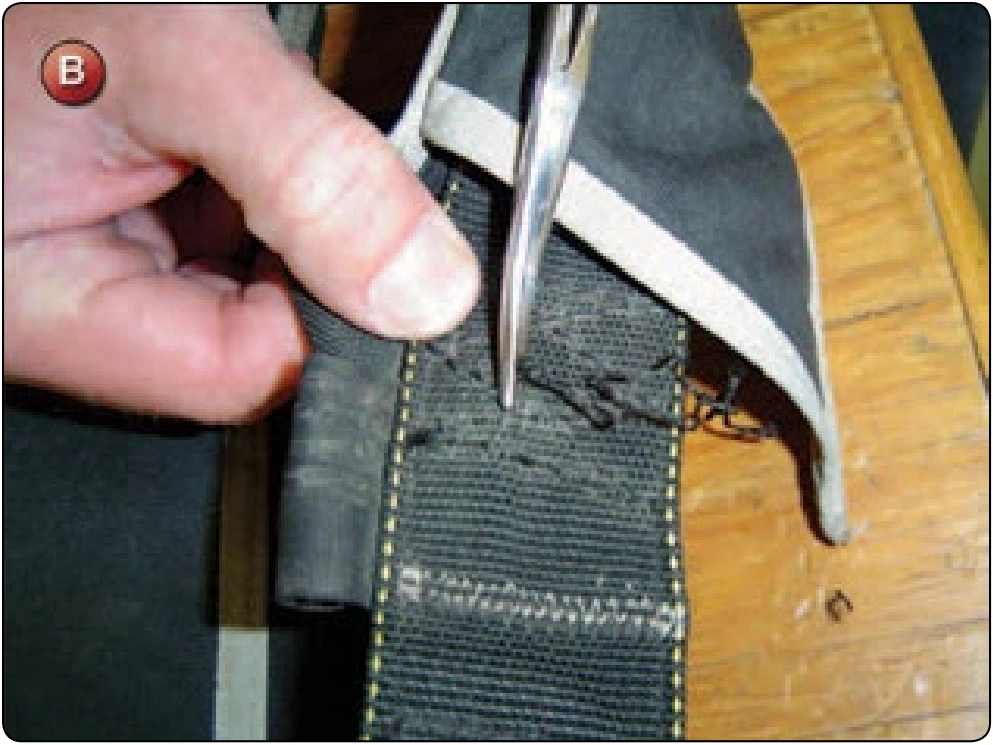
- Remove the harness stitching and any other stitching from the junction making sure not to damage the main lift web. [Figure B]
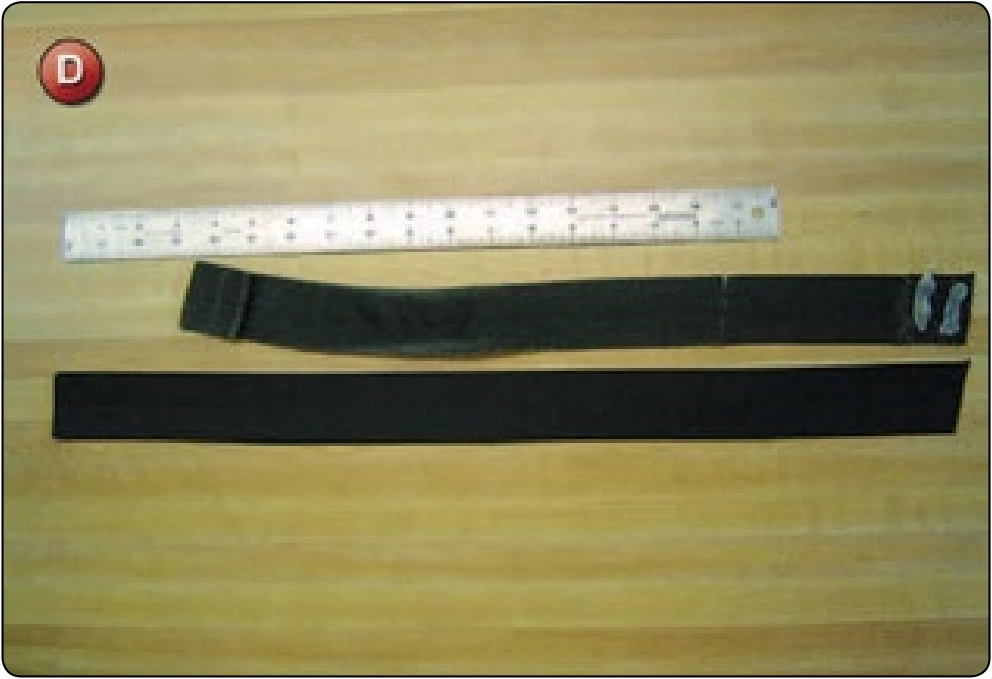
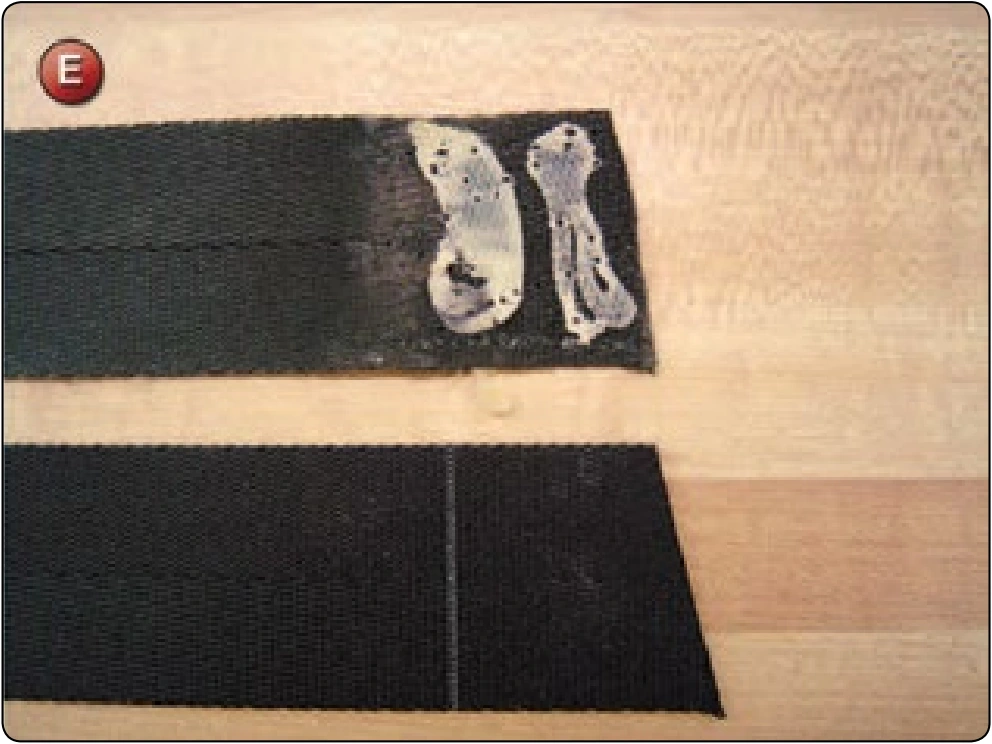
- Remove the old chest strap webbing from the main lift web. Pay particular attention to the end of the webbing. While most chest straps are installed at right angles to the main lift web, some have an angle cut at the end for better fit. If the webbing has an angle, make sure to duplicate it.
- Clean the junction area of old thread, as well as any glue residue on the inside of the main lift web.